

When our family moved to the Durango area in 2021, I started to prepare for a disaster. I always assumed it would be a wildfire—not the catastrophic flooding that swept through the Four Corners region in recent weeks.
As a journalist, I’ve covered fires, floods, extreme weather, and our evolving water cycle for decades. But it’s usually been at a distance, either physical or emotional. This time, the danger and destruction reached my own neighborhood and community.
Watching the water and debris ruin homes and transform familiar landscapes has been shocking, depressing, and strangely awe-inspiring.
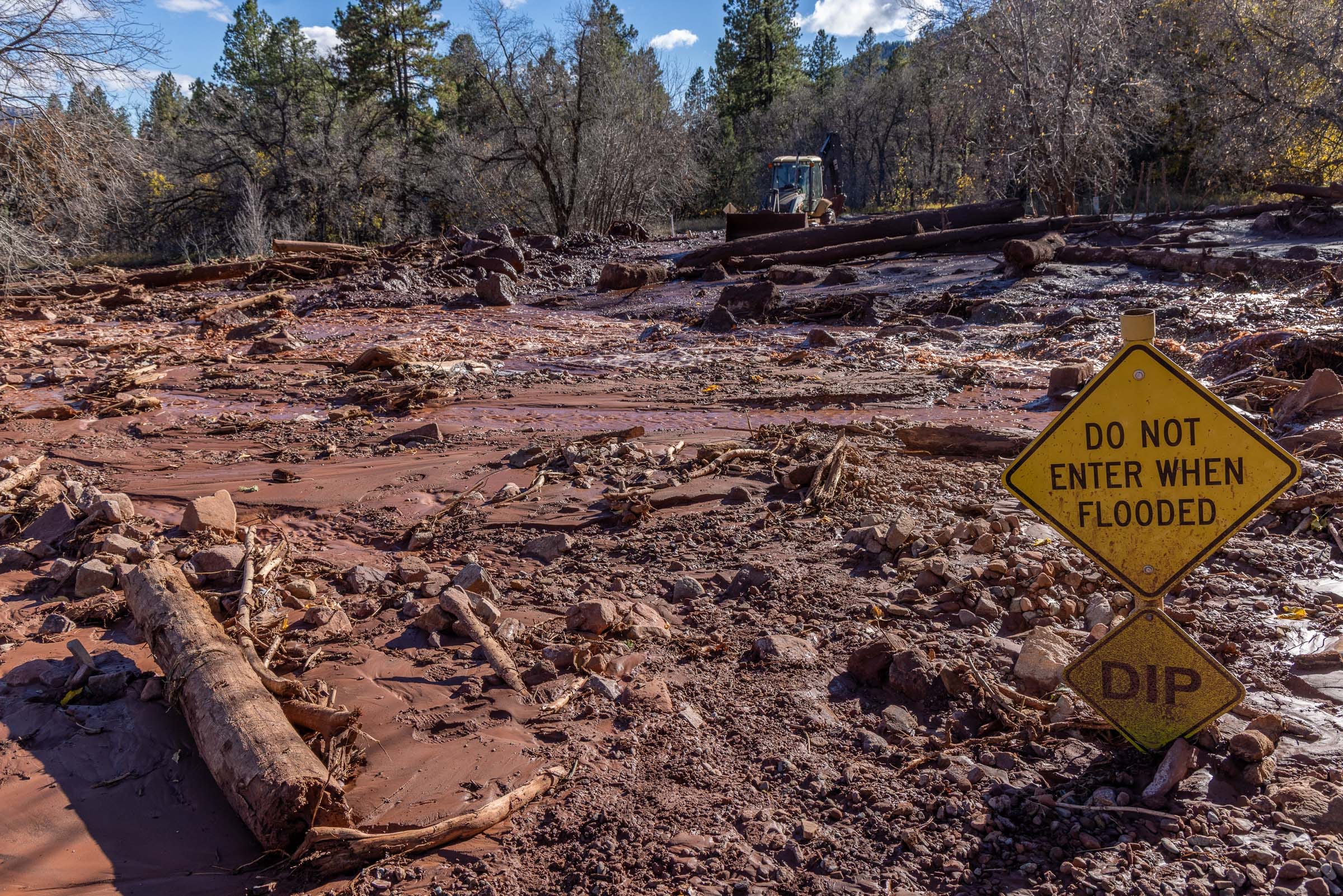
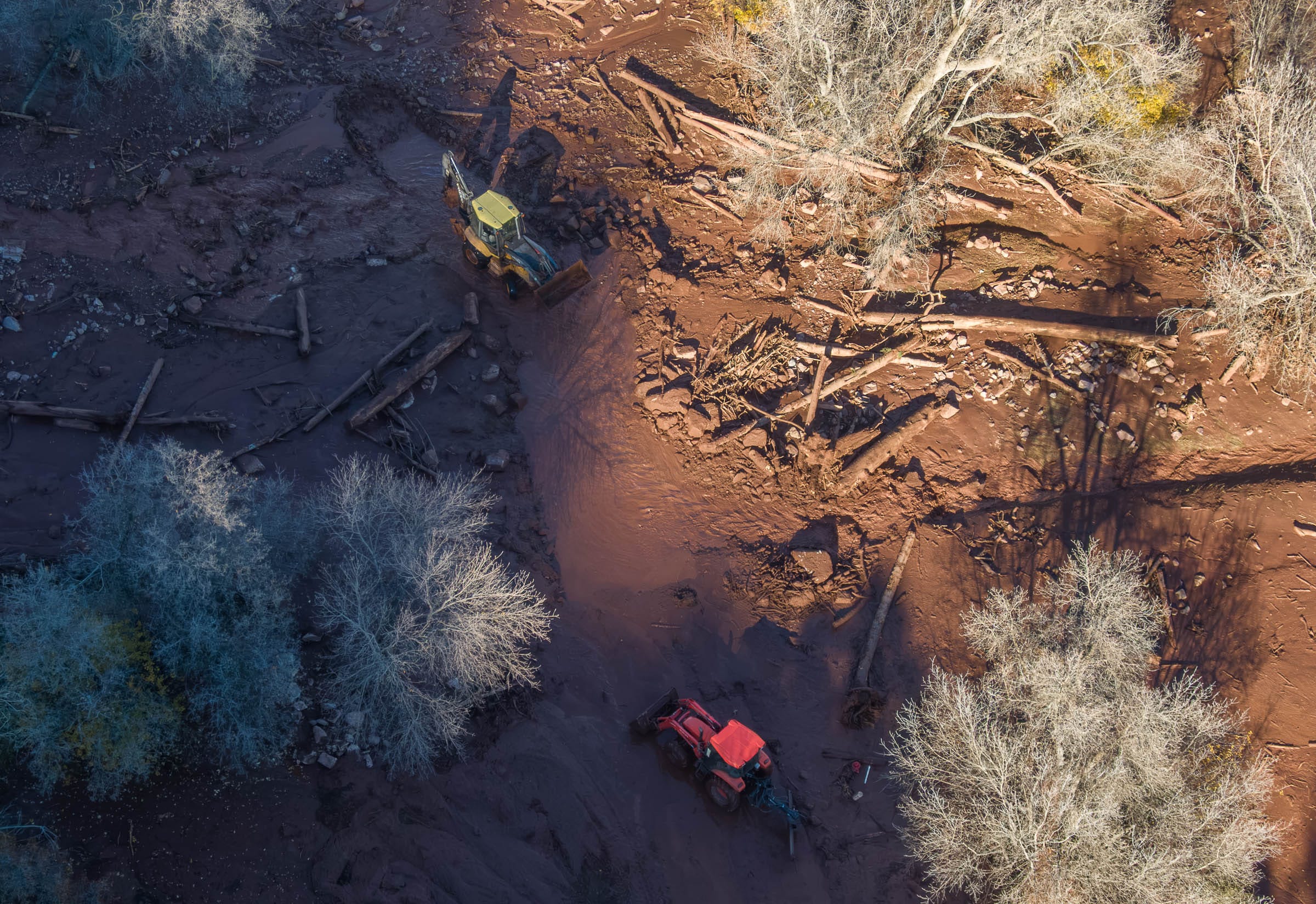
In the days and weeks since the flood, I’ve photographed washed-out roads, inundated mobile home parks, and canyons reshaped by erosion. I’ve watched excavators struggle to clear huge boulders and tree trunks from places where water almost never flows.
These experiences have left behind indelible memories and painful lessons I want to share because so many others are also in harm’s way as the 21st-century climate intensifies both droughts and floods. This fall’s devastating runoff from the San Juan Mountains also highlights how the shifting boundary between rain and snow can put downstream residents at risk.
During this historic event, I’ve also been questioning my role as a journalist in a fragmented information ecosystem that feels like a different planet from the one I occupied as a newspaper reporter covering wildfires a quarter-century ago.
From fire fears to flooding
This summer, I worried about flames destroying my house after a record winter snow drought and spring heat wave. I breathed lots of noxious smoke from nearby fires, yet we dodged the threat and were overjoyed when the rains came in September after a spotty monsoon.
But then the rains wouldn’t stop.
By the end of October, my rain gauge had recorded nearly 17 inches in just two months. Then, on November 1, an atmospheric river plowed into the already saturated San Juan Mountains, unleashing tropical moisture on a semi-arid region naturally prone to flash flooding.
That Sunday afternoon, while I was watching the Broncos game, I heard the unexpected and unmistakable sound of rushing water. I looked out my kitchen window and saw a muddy torrent sweeping across the normally dry meadow near my house.
I went out to investigate and found the flood had already overwhelmed the culvert beneath the dirt road leading to my house. From there, the water raged down a steep gully that’s typically bone dry.
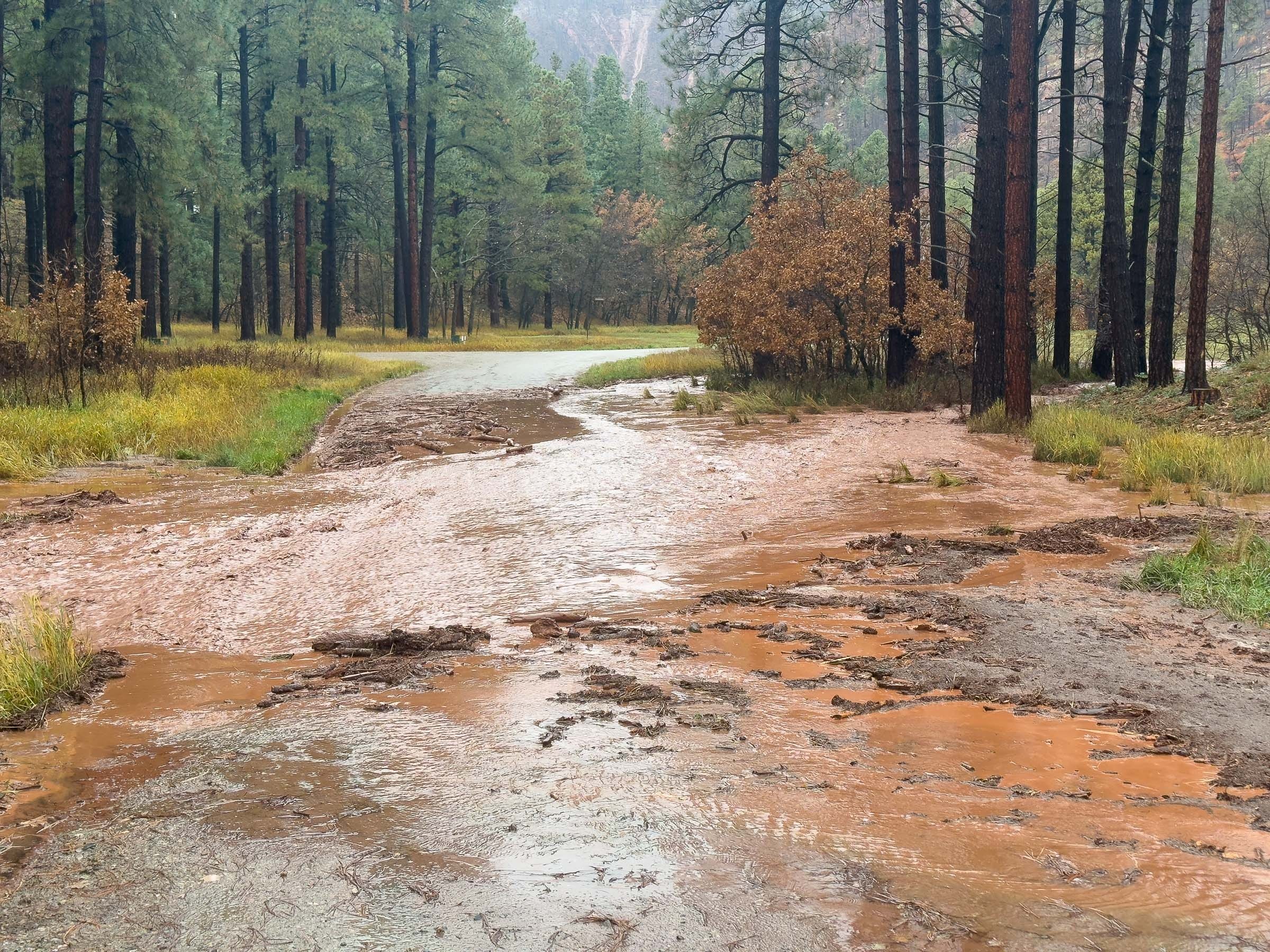
My wife and I trudged through mud near our home to assess the damage. I quickly realized I was covering breaking news in my backyard.
I stayed up late, juiced by adrenaline, and went down to the flooded road in a failed bid to photograph the runoff at night. The current was now wider, deeper, and louder. I could see large pieces of wood streaming by in my headlight’s beam.
I didn’t capture any usable imagery, but what I heard on that foray stunned me. A thunderous boom echoed across the meadow. For a split second, I thought it was a lightning strike, but then I understood it was boulders and other debris hurtling down the nearby cliffs, where the massive 416 Fire had burned to the edge of our neighborhood in 2018. I later learned that a neighbor’s garage had been pummeled at some point by material crashing down the slopes.
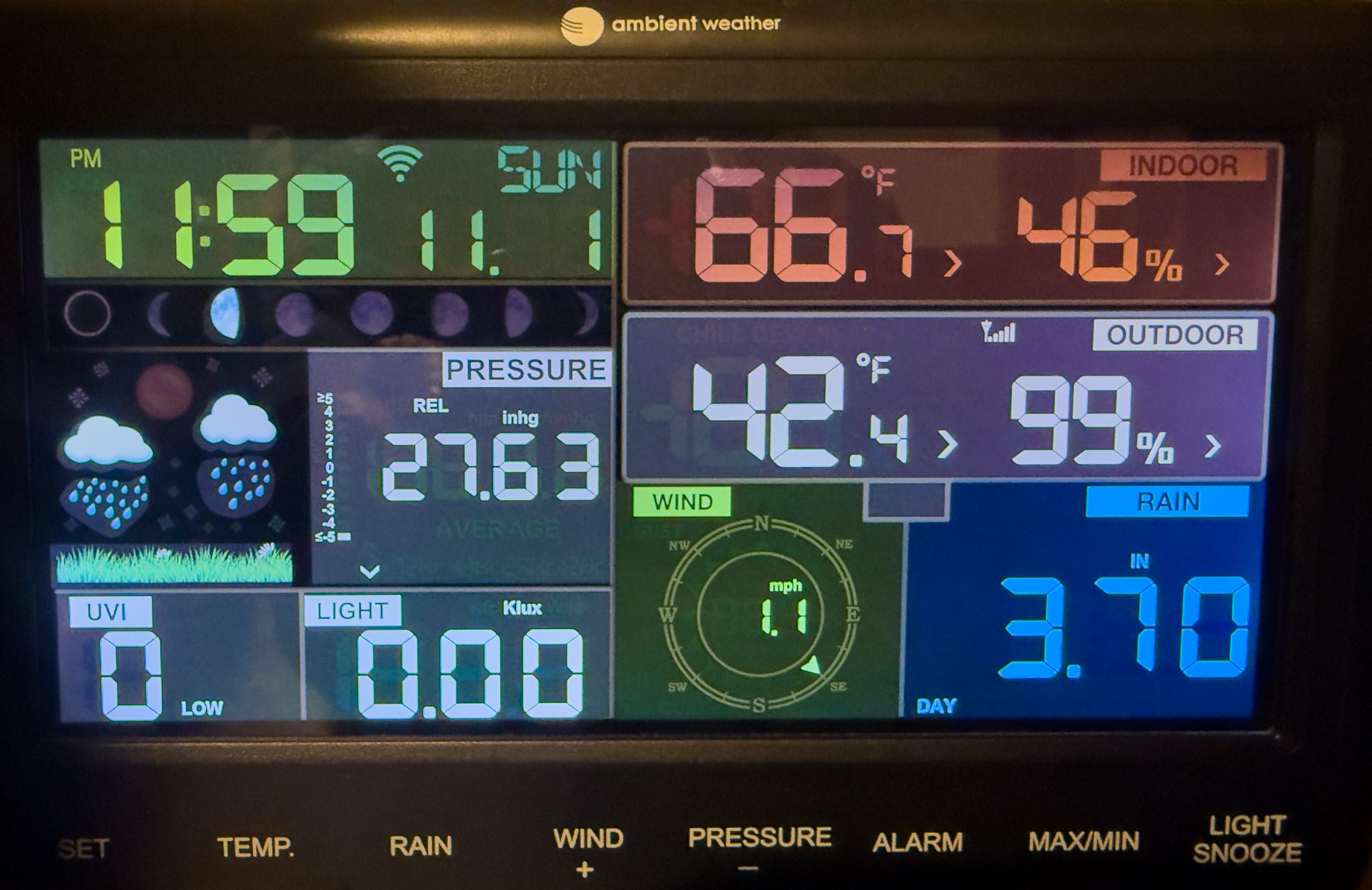
Ever the weather nerd, I headed home to take a photo of my station’s dashboard before the stroke of midnight to record the mind-boggling total of 3.70 inches of rain in a day—apparently I needed photographic proof.
The next day, I hastily posted on snow.news about the flooding, but in retrospect, I had only begun to grasp the scope of the calamity.

The roar of water and mud had reached a crescendo overnight, leaving me stranded in my neighborhood for days because of road closures. I could only hike or fly my drone to observe nearby conditions. It was hard to size up the damage in town or across the region, where news coverage is stretched thin across a vast, sparsely populated landscape.
Our daughter was stuck on the other side of Durango at a Halloween sleepover that would last much longer than expected (she didn’t mind). School would be canceled for two days.
Colorado Public Radio contacted me, so I started sharing my photos with them and offered an eyewitness account of the damage on their podcast. I also took photos for Four Corners Public Radio. All the while, I struggled to balance the journalist’s imperative to document the news with my desire to help neighbors—and my need to take a breather.
Familiar landscapes transformed
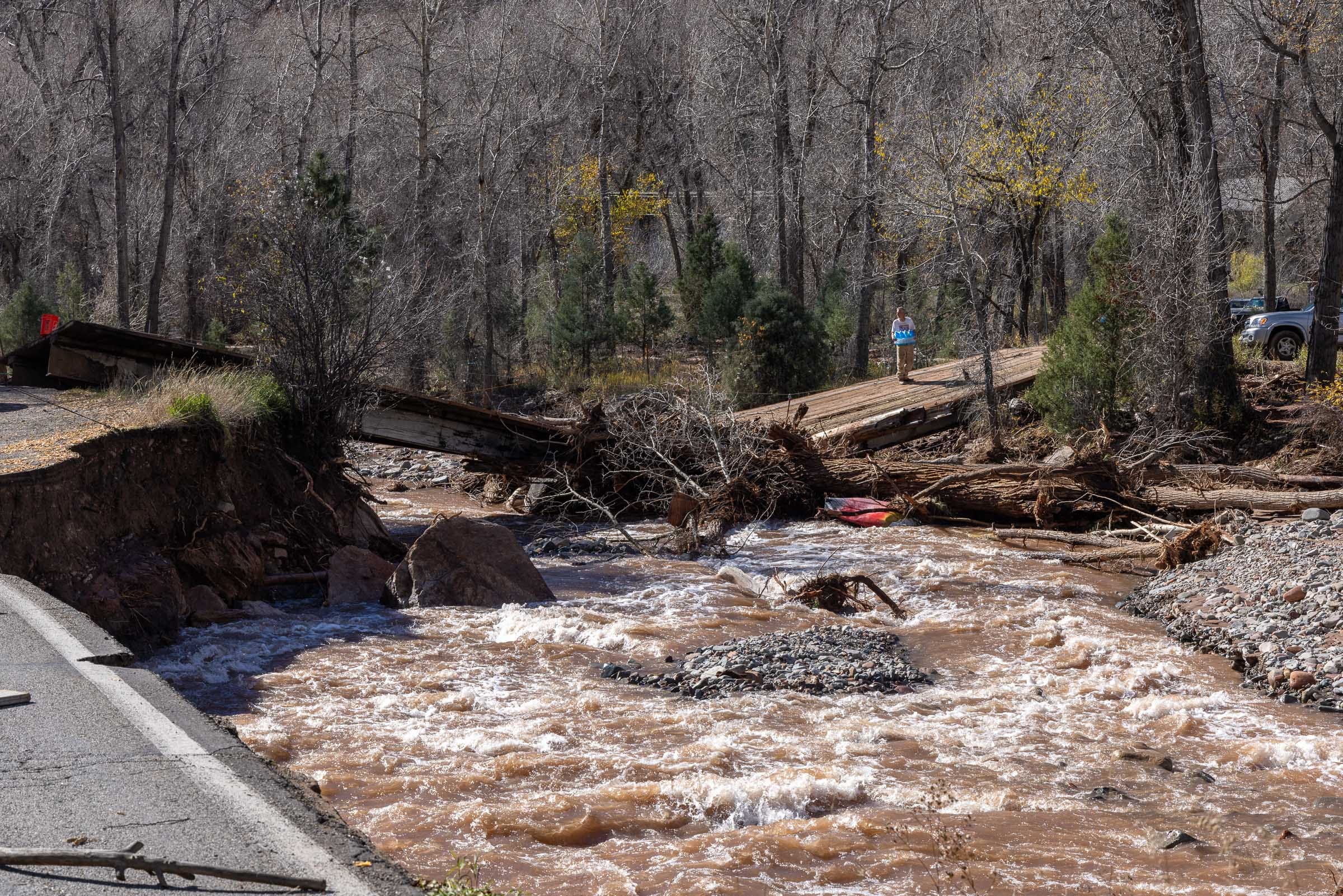
I finally made it out of my neighborhood on November 4 and was amazed by what I saw. On my way to Durango, Junction Creek—often a dry, narrow streambed in this stretch—was still rampaging toward the Animas River. The flood had scoured a wide swath through the valley bottom, damaged many properties, demolished several bridges, and overrun the county road I drive on nearly every day. This spring, the snowmelt in Junction Creek was a relative trickle.
Within the Durango city limits, Junction Creek had jumped its banks with ease, deluging neighboring streets and properties with a thick muck that crews were trying to scrape, shovel, scoop, and otherwise clean up with heavy machinery and their own two hands.


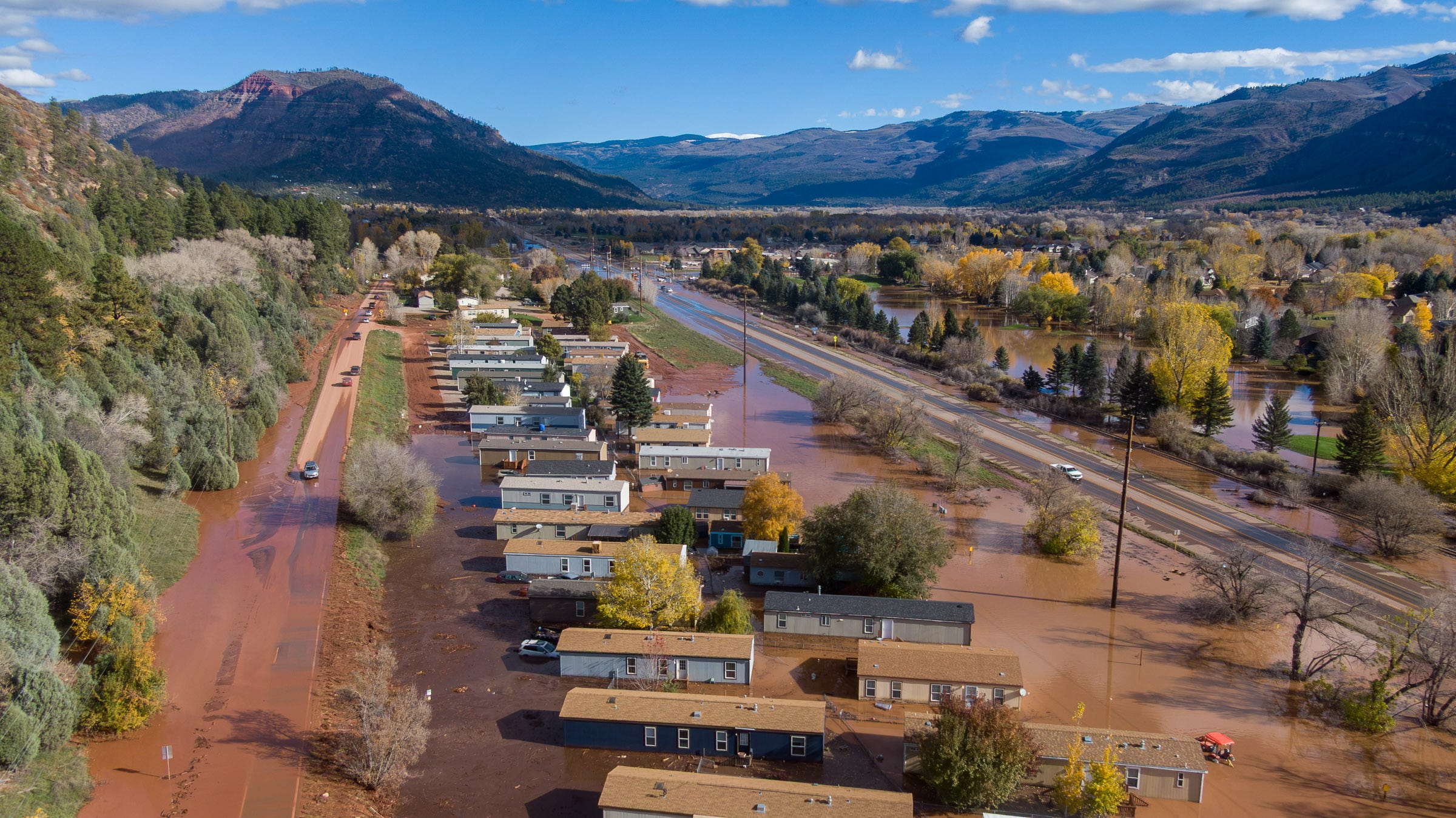
North of Durango, low-lying areas were still submerged, and U.S. 550 was closed. Water was still flowing through the streets of the Hermosa Vista neighborhood, where residents and volunteers had deployed lines of sandbags to keep the flood out of homes.
“It was like every sandbag you put down, all of a sudden the water was on top of it,” recalled Adrea Bogle, president of the neighborhood’s homeowners association. “So you’re throwing another one down, the water’s on top of it.”
But as the residents struggled to contain the flooding, help began to arrive.
“Magically, truck after truck started coming in from town with volunteers, just people showing up with truckloads of sandbags, and it didn’t stop until last night when we were done,” Bogle said. “The community showed up.”
Despite the crisis, everyone I spoke to while reporting was gracious. Everywhere I went, neighbors were helping neighbors. One silver lining of the disaster was seeing the community come together and pitch in selflessly with recovery. People were certainly stressed, but the lack of animus in the Animas River watershed was a ray of light during dark days.
Just in La Plata County, home to Durango, local officials estimate the damage at tens of millions of dollars. About 4,500 people were evacuated, and more than two weeks after the November 1 flood, some folks still haven’t returned home.
A newfound sense of vulnerability
We’re grateful to live on a hill and to have escaped harm to our property. But some of our neighbors and many people across the region weren’t as fortunate, so I’ve been grappling with survivor’s guilt.
Even though our home wasn’t inundated, the experience left me feeling uneasy and vulnerable because the damage was so close and my overland connection to civilization suddenly felt tenuous.
The photos below show two choke points on my drive to town where the road was closed for a while but thankfully didn’t wash away completely.


There’s now one lane open at these bottlenecks, but heavy loads are restricted, so we initially worried whether the big propane tankers could get through to deliver fuel to heat homes this winter. Fortunately, it looks like half-load propane deliveries will work. Amazingly, our 100-lot subdivision’s water system survived the hydrological onslaught.
But repairing the collapsed private road in my neighborhood will require an estimated 1,800 tons of fill, 200 hours of trucking, and lots of labor—all of which will cost our HOA a small fortune on top of other recovery efforts. There’s already talk of a possible special assessment for homeowners to pay for the repairs.
Disasters often hit the least advantaged hardest
Our neighborhood suffered, but we’re in a much better position than many communities in the Four Corners to recover and foot the bill. The most heartbreaking aspect of this tragedy is that so many of the victims were already disadvantaged before the flood.
I saw this in late October, when I photographed the flooding San Juan River in Shiprock, on the Navajo Nation in northern New Mexico, where the poverty rate is about 35%, compared with 13% in Durango.
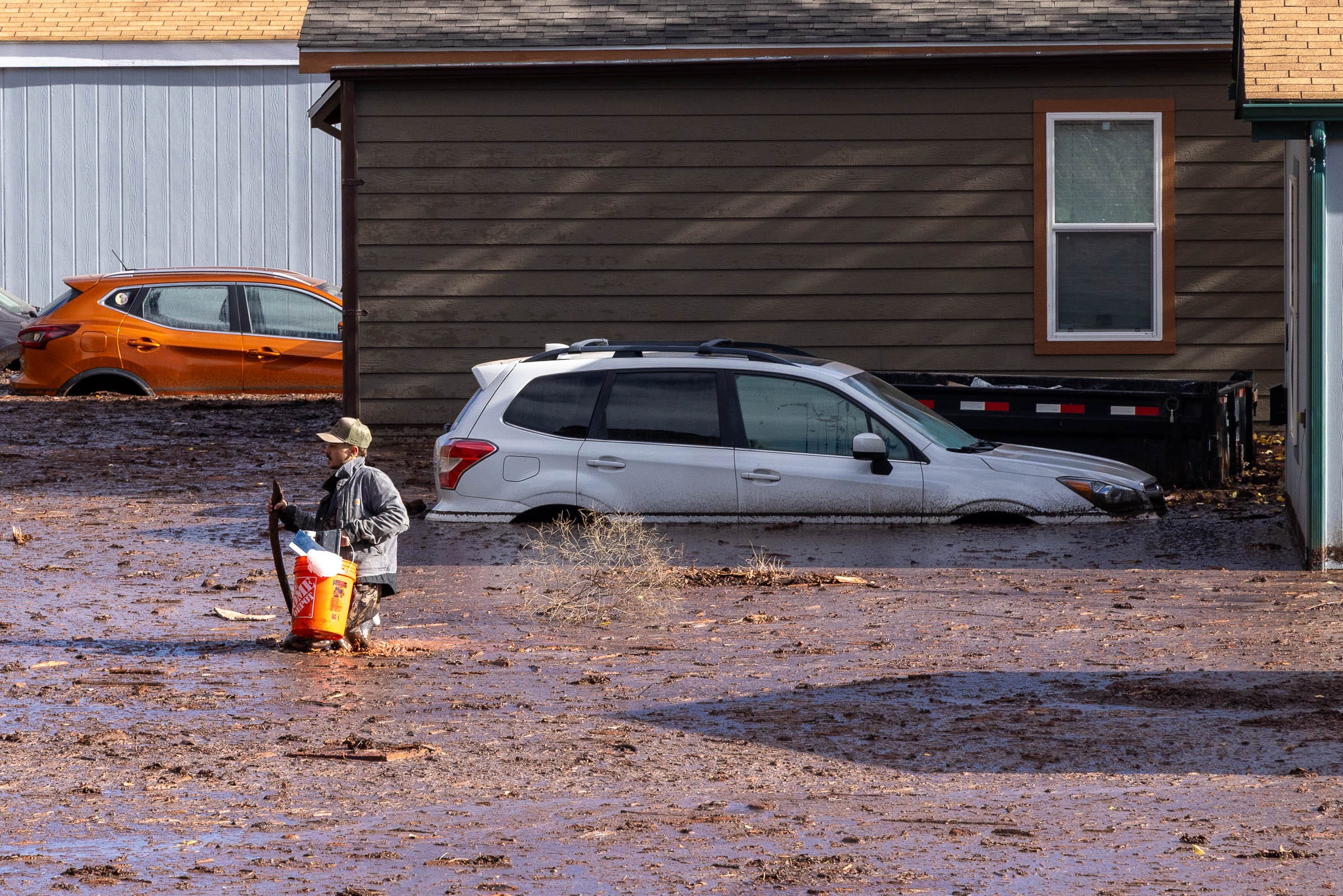
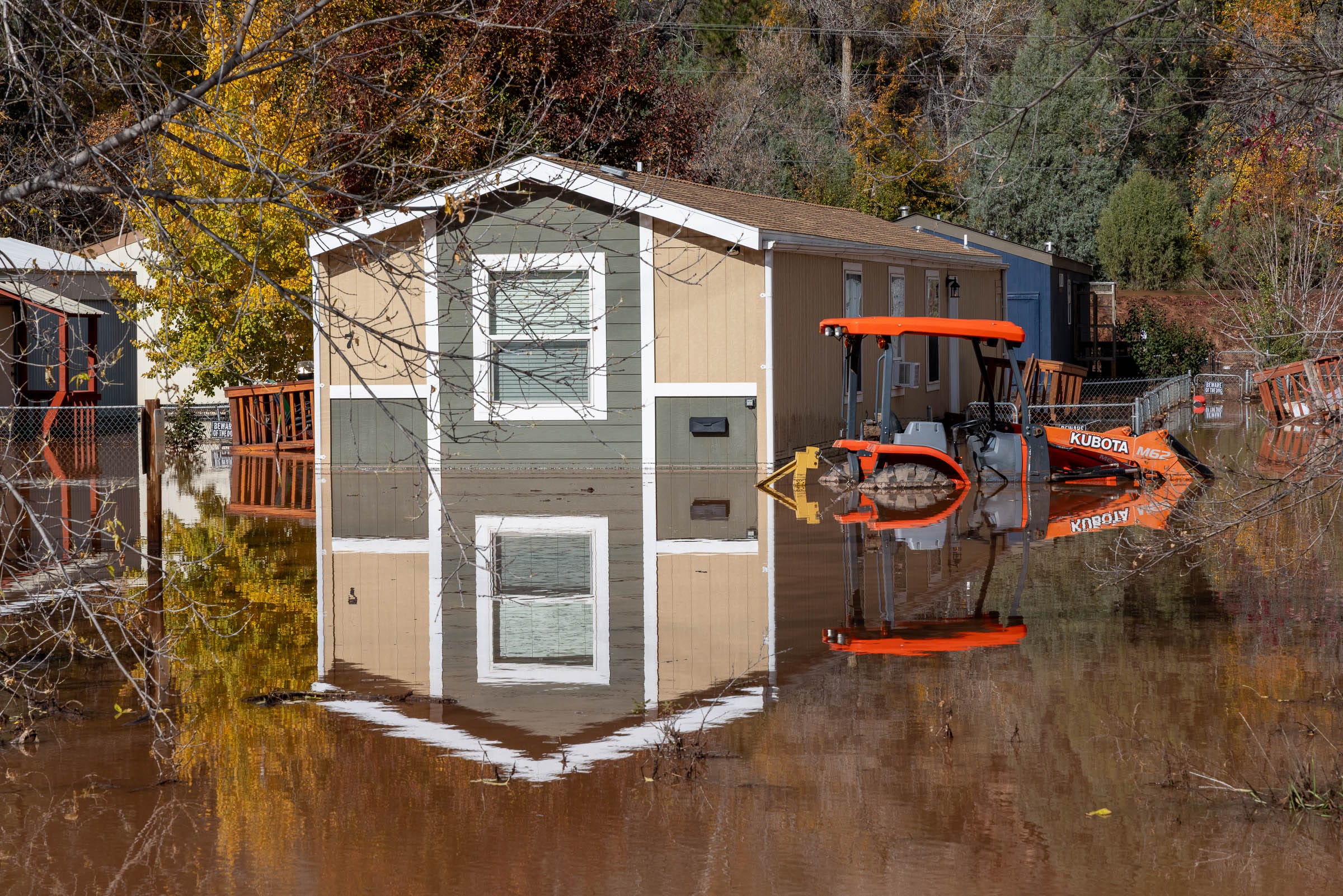
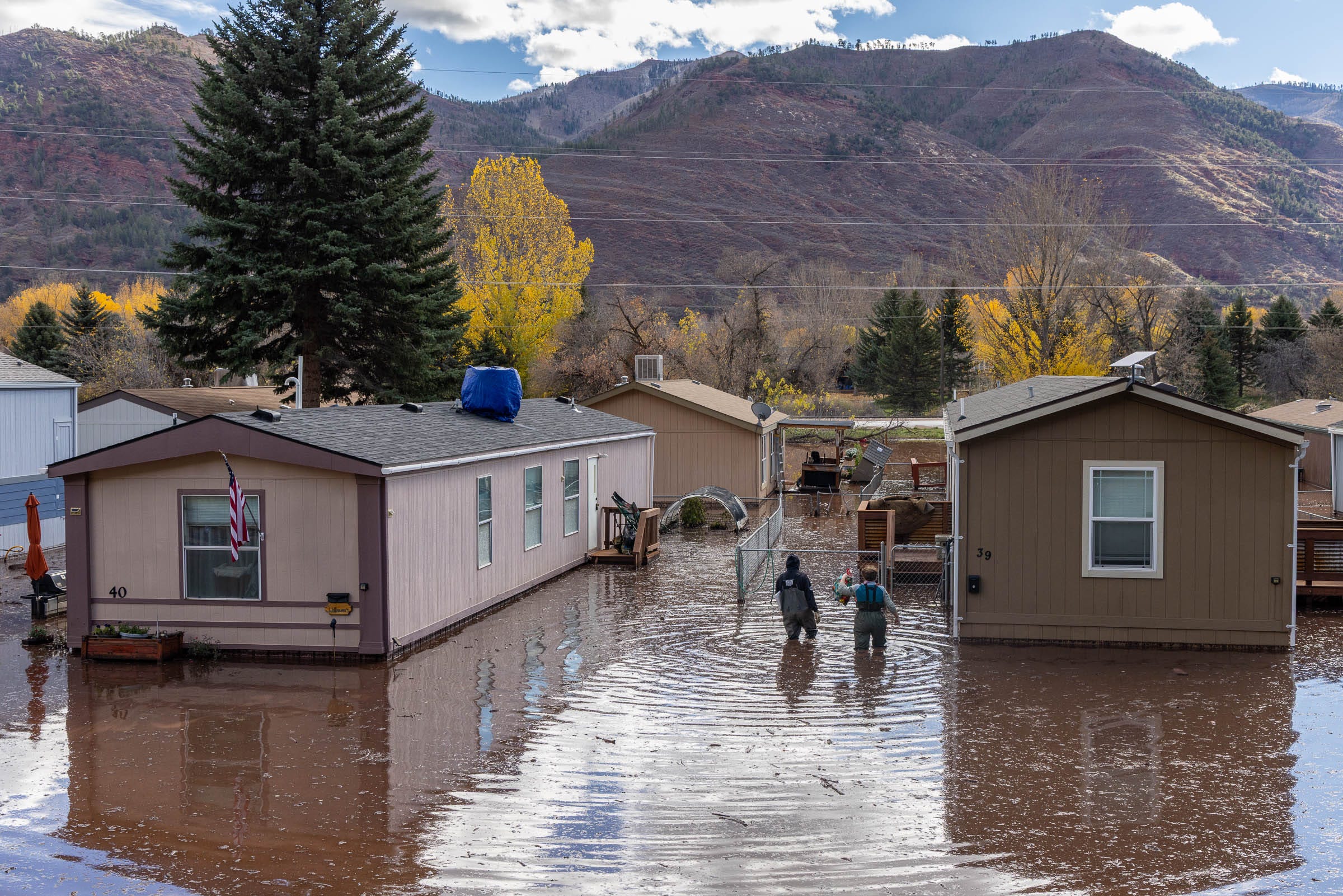
Along Junction Creek in November, the flood didn’t spare million-dollar properties, but some of the worst damage looked to be in a mobile home park, where propane tanks were tossed around, and yellow caution tape barred entrance to the community.
Near Trimble, trailers looked like houseboats in a muddy bay as residents waded and paddled to retrieve their possessions.
Water always wins: the enchanting scourge of erosion
The flood has made me feel sad, nervous, and helpless, yet I must confess to periodic surges of awe and wonder as I’ve witnessed nature’s power to upend our notion of what is normal or even possible.
The same thing happened when I covered wildfires in Arizona in the 2000s as a newspaper reporter. Flying in a Cessna over tens of thousands of burning acres instilled a profound sense of my own insignificance. Seeing how the Durango flood had tossed boulders around brought back that same humbling feeling.
Intellectually, I knew that moving water was powerful, that each gallon weighs more than eight pounds, that flooding is a costly, deadly menace for society. But I’m still dumbfounded by what the runoff did to the landscape around me.
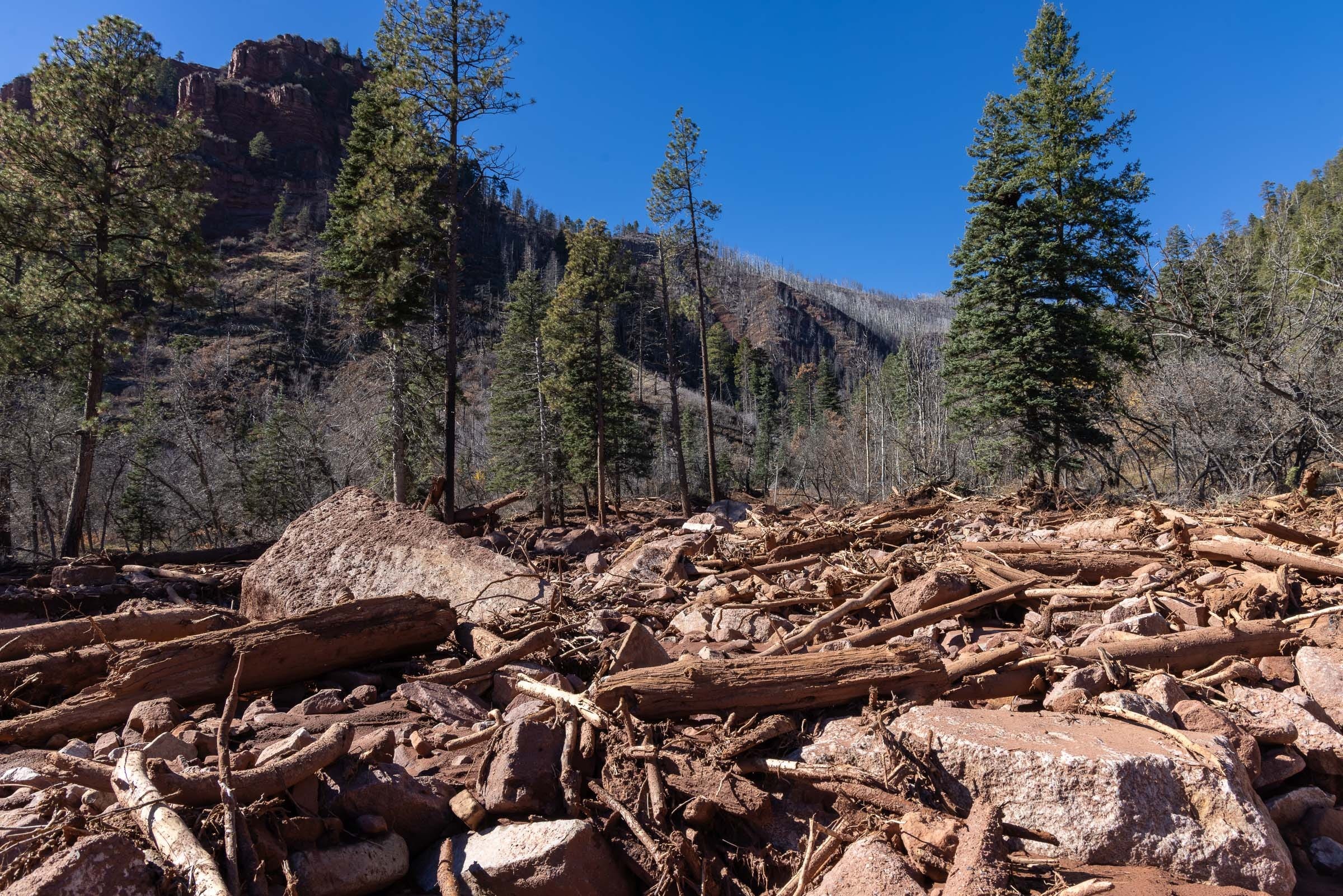
Erosion is one reason people move to Durango and travel from around the world to visit the Colorado Plateau and San Juan Mountains. Over millions of years, the indomitable forces of water, ice, and wind have sculpted the Four Corners region into some of the planet’s most spectacular geologic formations.
I’ve tended to think of erosion as proceeding at a glacial pace over deep geologic time. During the flood, I watched and filmed it live.
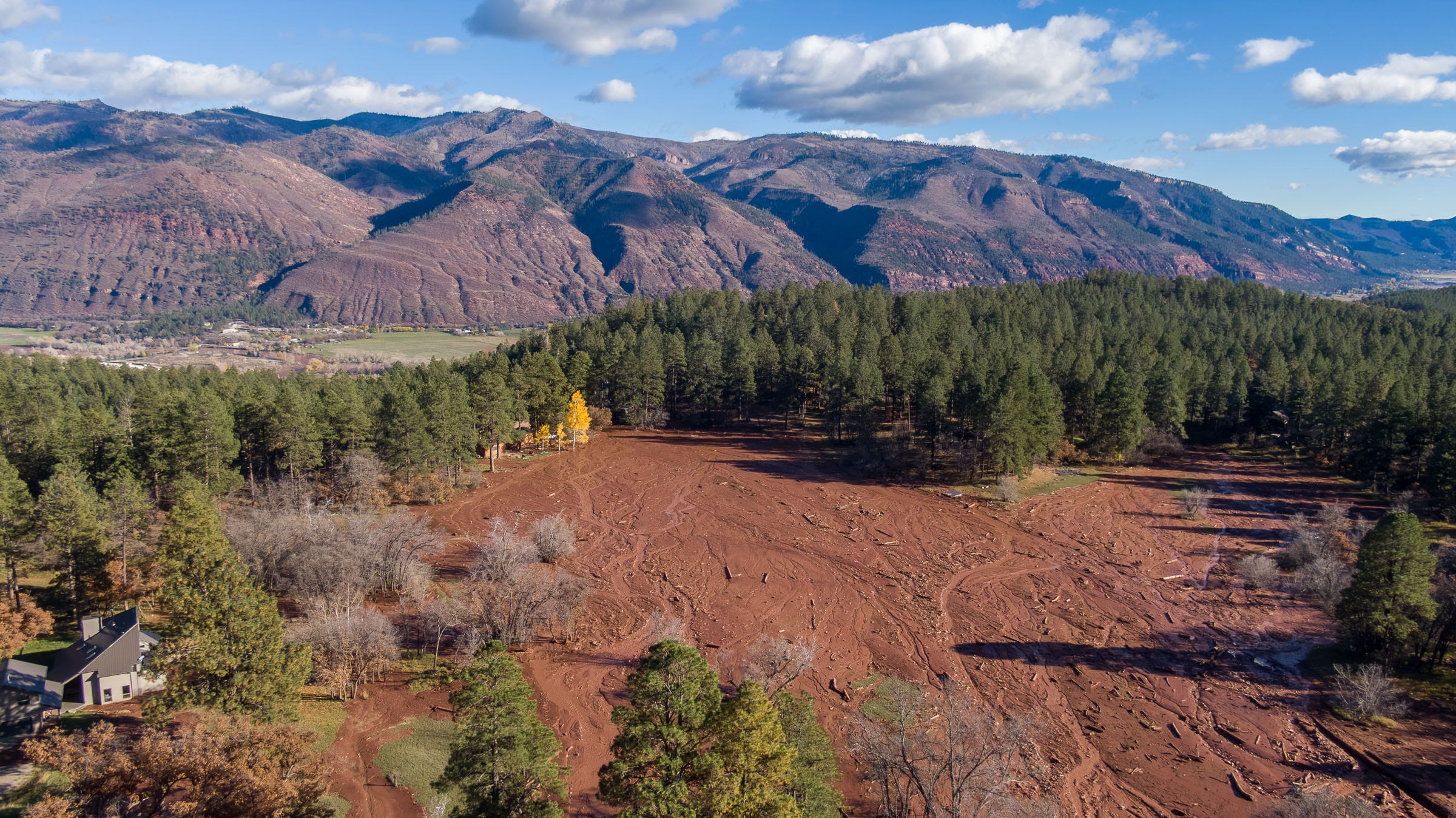
In the drone shot below, about a mile from my house, the colorful cliffs in the distance are a selling point for local real estate. But the sediment-covered meadow illustrates the destructive power of the same forces that create picturesque landforms.
The lasting legacy of wildfire
Paradoxically, a severe drought eight years ago helped set the stage for a historic wildfire that appears to have worsened the recent flooding in my neighborhood and downstream.
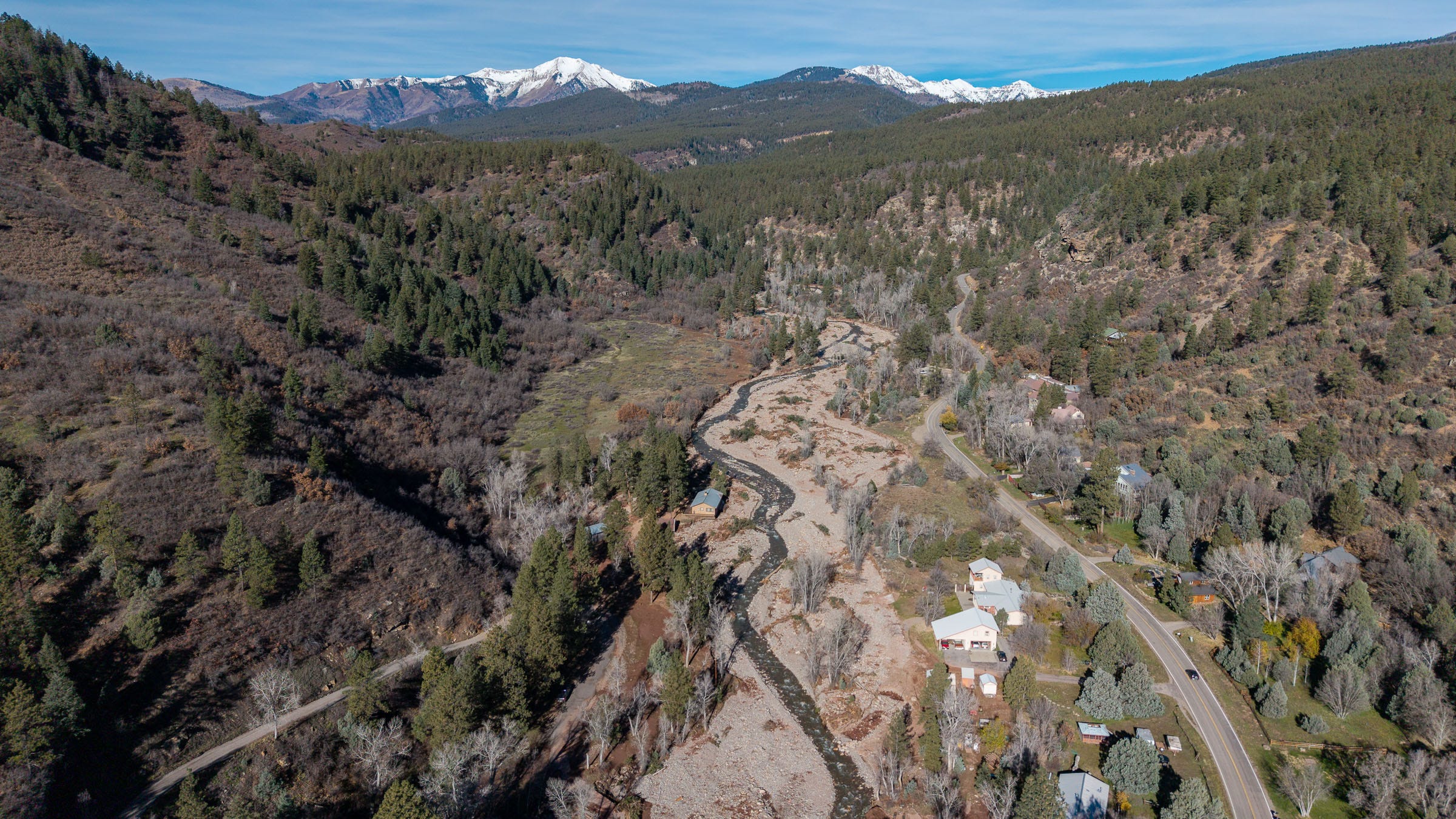
The short drone video below shows the flood’s aftermath in two watersheds near my home that were severely burned during the 416 Fire, which scorched about 54,000 acres.
After the 2018 blaze, there was post-fire flooding and erosion, but over time, ground cover, scrub oak, aspen, and other plants began returning to the slopes and canyons above our neighborhood. The vegetation grew so thick in one canyon bottom that it became an ongoing task for volunteers, including me, to clear the trail.
Now that path is a deeply incised channel—with banks more than 10 feet high in some places—that will require canyoneering to ascend the cascade of mud, rocks, and logs.
Since the flood, I’ve used my drone not only for photojournalism but also to survey the burn scar to inform downstream residents and our HOA. What I’ve seen from the air is striking, but it’s hard to communicate in photos because there’s no human frame of reference to judge scale. In the images below, shot hundreds of feet above the ground, a person wouldn’t take up many pixels.
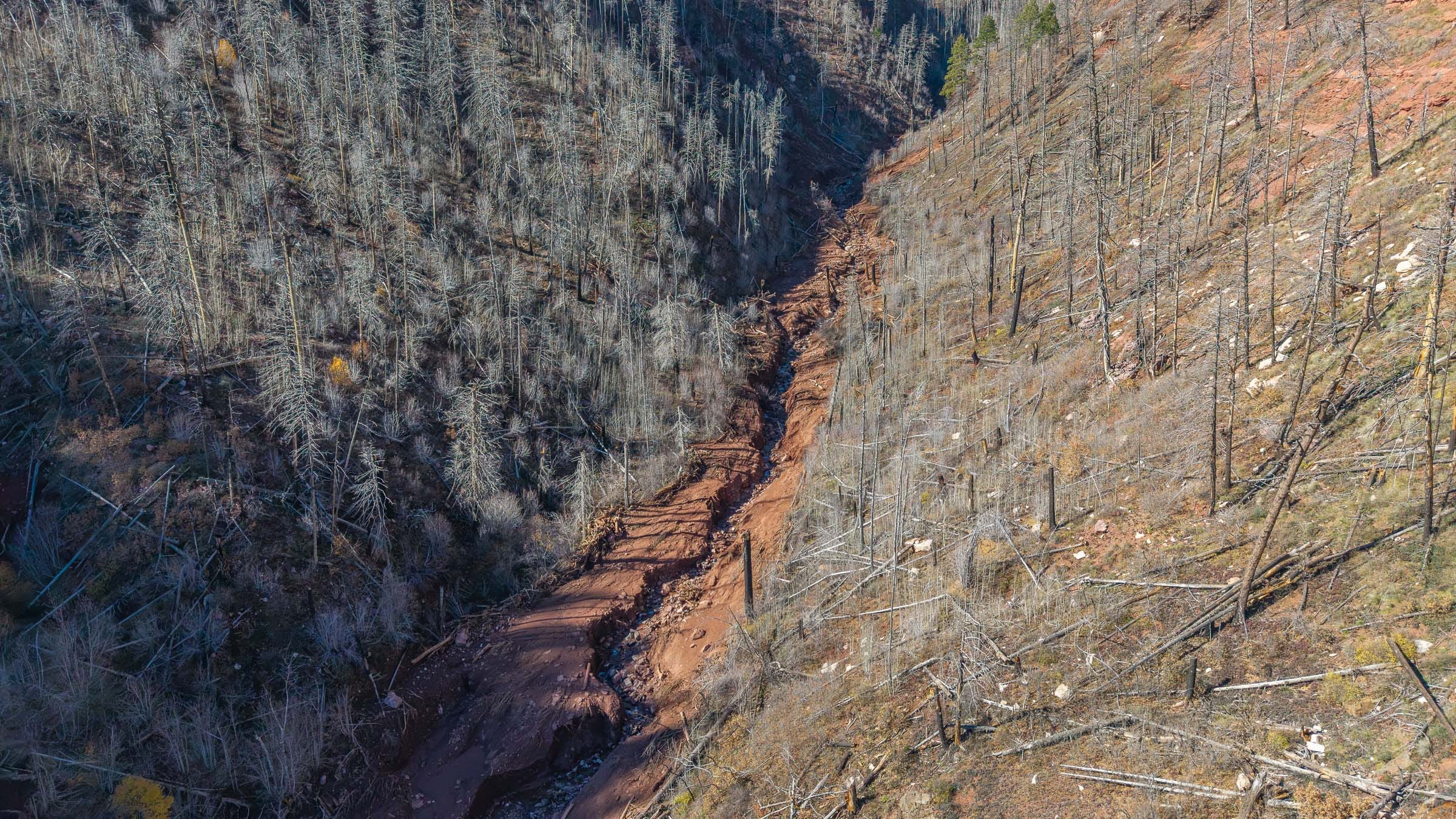
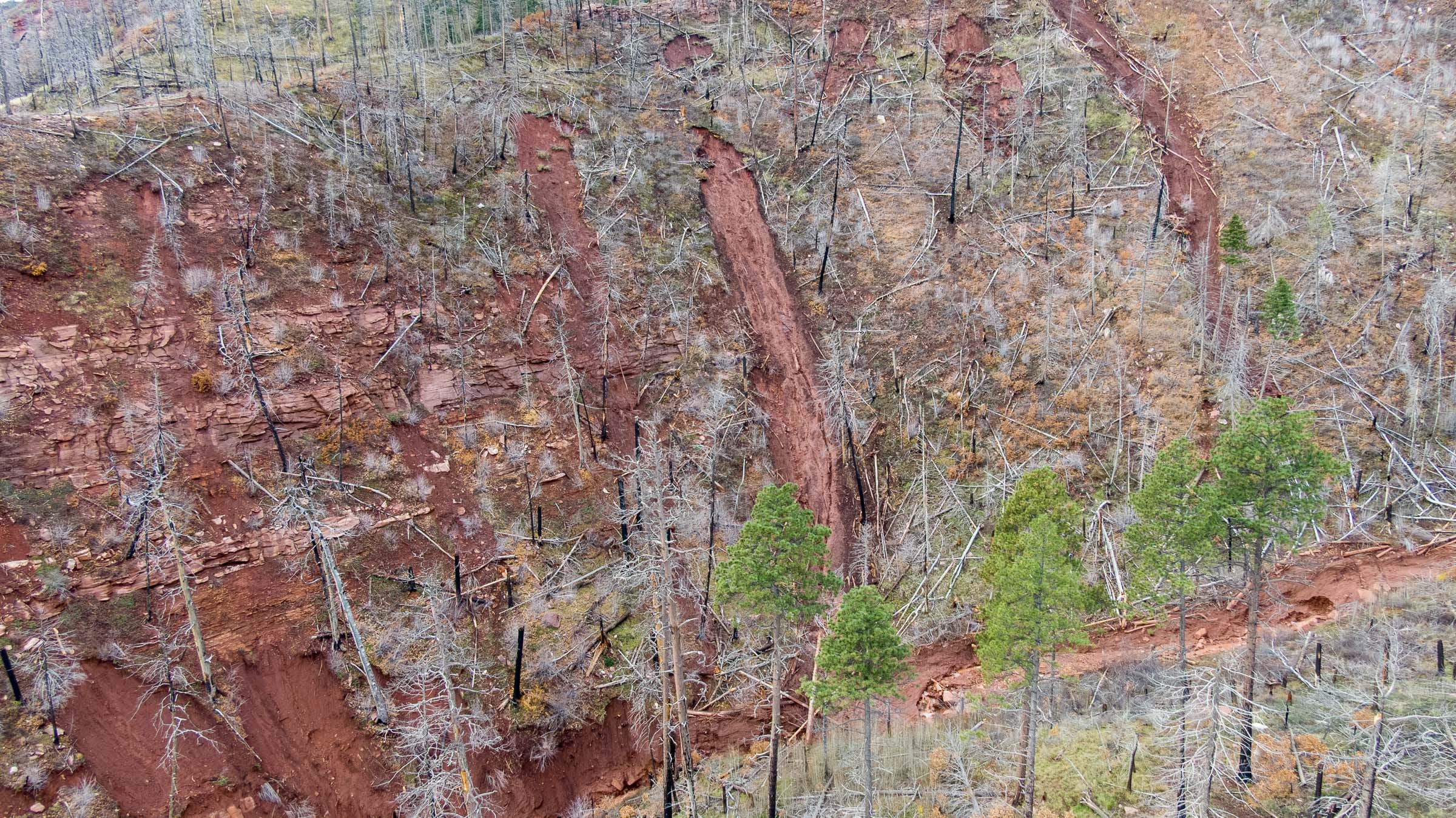
I’m no scientist, but I suspect that an informative natural experiment happened near home: just south of these two burned drainages lies a similar canyon that escaped the flames in 2018. That creek certainly went crazy during the flood and overtopped a road, but the erosion and downstream impacts were comparatively slight, even though the watershed it drains is far larger.
Wildfire-related runoff problems generally diminish over time as vegetation recovers, but the severe erosion in these drainages suggests a long tail to the effects of the 416 Fire—and makes me wonder if the canyons are now even more vulnerable to flash flooding in the years ahead.
Why rain versus snow matters
When the atmospheric river struck on November 1, snow levels were unusually high in the San Juans, with rain falling across much of the range. Had the storm been significantly colder, I might have been posting face shots from epic early-season powder days, rather than images of flooded neighborhoods.
In the wake of the disaster, I reached out to Seth Arens, a research scientist at the Western Water Assessment at the University of Colorado Boulder who co-authored a rapid assessment of the fall 2025 flooding in southwest Colorado, which spared our neighborhood but hit other areas hard.
WWA is preparing to publish a new analysis of this year’s flooding, but in the meantime, Arens offered some insights. In Colorado and Utah, “all of the snow levels were significantly higher than you’d expect this time of year,” Arens said. But as bad as this fall’s flooding was, it might have been even worse had more of the precipitation fallen as rain rather than snow.
“Some of that flooding was probably dampened a little bit by the fact that you were getting snow at the highest elevations,” Arens said. Last fall’s storm delivered virtually all rain, but this year, at least some of the moisture got stored in the snowpack and didn’t contribute to flooding.
“These October storms, historically, 60, 80 years ago, probably were colder than they are now,” Arens said, adding that fall flooding risks in the region will likely grow “as we move forward in time and temperatures become warmer and warmer because less and less of those storms are going to be falling as snow.”
Photojournalism is harder than it looks
I broke into journalism at the very end of the 20th century, during the waning years of the newspaper industry’s dominance. I scribbled notes and quotes on a pad. I typed them up on a primitive computer. Then I waited for my words to land with a thud on the driveways of tens or hundreds of thousands of people, my clipped prose surrounded by flowery advertising that would evaporate with the internet’s rise.
During this fall’s calamity, I was primarily a photojournalist and drone pilot, often distributing content myself via social media and other digital channels that didn’t even exist when I was an ink-stained wretch.
When I was purely a writer, I felt a mix of respect and envy toward my photojournalist colleagues. I deeply admired their work, but I also figured they had it easy compared to my job: just go out, shoot a few frames, slap on some minimal captions, and you’re done. Meanwhile, I was scrambling to verify facts, track down figures, record accurate quotes, and capture telling details in a frantic bid to construct a clear narrative amid the chaos.
Now I know much better.
As I’ve devoted more of my time and energy to visual journalism, I’ve come to appreciate how difficult photography can be, especially during breaking news, when just getting somewhere you can use your camera is often a logistical nightmare or impossible.
Even when I had a promising vantage point of the flooding, the assignment was challenging. There were the usual puzzles: light, shadow, composition, aperture, ISO, and shutter speed. But now I was straining to remain upright in a filthy, gelatinous goo that sometimes enveloped me up to my waist. My heart rate soared as I tried to wiggle free and recalled the unnerving experience of falling on a deep powder day, losing both skis, and fighting to find my footing.


The emotional toll of disaster journalism
Whether I was writing about wildfires decades ago or photographing flooding in recent weeks, I was reporting on trauma and tragedy. For me, this territory is both familiar and uncomfortable. Disaster journalism can feel like being a vulture as you make a living off others’ misfortune.
As a newspaper reporter, my beats revolved around public policy and environmental issues, but I’d regularly “cover cops,” listening to the police scanner for homicides, fatal car crashes, and other emergencies. When a University of Arizona nursing student murdered three of his professors on campus, I interviewed eyewitnesses. And when the 9/11 attacks unfolded, I was at the Tucson airport, preparing to fly to a water journalism training, and had to break the terrible news to bewildered passengers whose flights had been diverted.
While covering crises, I’ve done some of the best and most meaningful work of my career, but the memories still haunt me. The recent 25th anniversary of 9/11 was tough for this native New Yorker. It also reminded me of a bygone era in journalism, when newspapers were far more influential and my work reached a huge, built-in audience without my having to distribute it myself.
Today, like many journalists working in the attention economy, I have to market my own work by chasing eyeballs and social media likes. During the flood, I found myself documenting my community's misery while also promoting my photos and videos, hoping they would reach a wider audience. One of my Facebook posts generated 160 sad emoji reactions, so at some level I was succeeding at my job, but that didn’t exactly put a smile on my face.
I'm grateful that my images and reporting have helped others understand what happened here. But after weeks of documenting the destruction, I’d much rather be photographing the endless beauty of this place I call home.