

1) Drought, climate, and the deadly Sierra Nevada avalanche
Tragedies like the recent avalanche deaths of nine backcountry skiers in California instantly trigger the blame game: Who or what was responsible for this grievous loss of life?
Social media commentators wasted only milliseconds before fingering the guide company for exposing clients to perilous conditions. I’m reserving judgment until we learn all the facts. This story by The New York Times, based on the accounts of two survivors, is gripping and the best description of the disaster I’ve read.
Another line of inquiry has focused on the conditions that primed the snowpack to release with such disastrous consequences—and the role of the preceding snow drought.
“Snow drought helped set the stage for deadly California avalanche, leading to unstable conditions” was the headline of a story by the Associated Press.
“When weather is dry and clear, as it had been in the Sierra Nevada since January, snow crystals change and can become angular or round over time,” the AP article said, paraphrasing Craig Clements, a meteorology professor at San Jose State University. “If heavy new snow falls on the crystals, the layers often can’t bond and the new snow forms what is called a storm slab over a weaker layer.”
Outside magazine reported that “changing weather patterns in the Sierra Nevada are challenging some long-held safety assumptions held by ski guides and avalanche professionals,” citing a longtime avalanche safety instructor:
“The Sierras are dealing with persistent weak layers, and they didn’t used to,” says Tarah O’Connor, a veteran guide and instructor with the American Avalanche Institute. “It used to be a Colorado and sometimes Utah thing.”
Connor, 43, told Outside that the Sierra Nevada’s traditional wet, heavy snow—affectionately called “Sierra Cement”—becomes loose and powdery after it sits exposed to air and sunshine without additional snowfall. “It’s like sugar, really weak, really gnarly,” she said. When heavy amounts of snow fall onto this layer after long periods of warm, dry conditions—as they did prior to the deadly avalanche—the danger of a deadly slide ratchets up considerably.
Some journalists and researchers have asked whether climate change is making avalanches more likely.
The New York Times noted that “climate scientists are identifying a paradox about snowfall, avalanche risk and a warming climate, namely that drier, warmer winters will occur in the West — but more snow is expected to fall at higher elevations.”
“While scientists are careful not to blame climate change for any single weather event without close study, research suggests that a warming climate is increasing the overall risk of avalanches at higher elevations, as storms dump large amounts of snow that can overload and tumble down a mountain slope,” according to the story.
In 2024, researchers published a review of the scientific literature examining how climate change is affecting avalanches. Here’s an excerpt from the paper’s abstract:
The limited availability of comprehensive datasets, the potential confounding factors and the limitations of statistical approaches can make it difficult to identify trends in avalanche activity. However, available data indicate a general decrease in avalanche number, size, seasonality and active paths at low elevations, and an increase in the proportion of wet avalanches relative to dry avalanches. Increased snowfall at high elevations can lead to peaks in avalanche activity and an increase in the number of wet and slush-like avalanches. Activity patterns gradually shift from low to high elevations under continued warming.
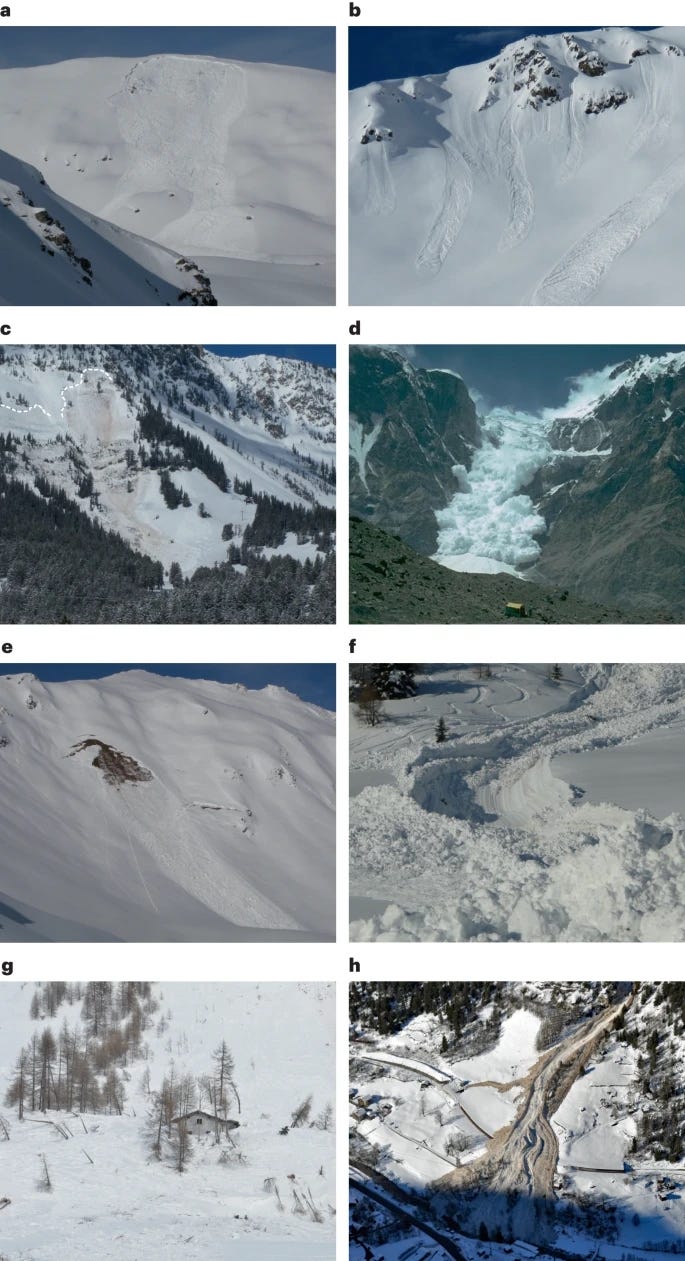
One challenge in studying avalanches is that they manifest in many different ways. The figure below from the 2024 review illustrates eight types of avalanches, each with its own dynamics.
2) Preserving snow with blankets
NPR reported that Idaho’s Bogus Basin has covered machine-made snow with insulating blankets to prevent it from melting over the summer so it can be used the following winter.
“Last summer, temperatures in Bogus Basin were in the 70s and 80s. But when the staff uncovered the pile last October, 80 percent of the snow was still there. It was densely packed but usable. The ski area's snowmaking crews then used special tractors to spread out the snow,” according to the article.
The resort paid $120,000 for its first set of blankets—far cheaper than the $6 or $7 million it would have cost to build a new retaining pond for snowmaking.
“It is a bit of weatherproofing, to protect against a season like this season, where not only did we have lackluster natural snowfall, we actually had warm temperatures that didn’t allow for snowmaking,” Austin Smith, Bogus Basin’s innovation director, told reporter Jaime Geary.
The blankets are made by Snow Secure, a Finnish company. The video below shows how the technology was used to provide “100% snow security” for a resort in Finland that was hosting a World Cup ski race.
3) Reintroducing wolverines to Colorado
Wolverines are badass carnivores that depend on the snowpack for their survival. A member of the mustelid family—which includes weasels, martens, and otters—wolverines are about the size of a small dog, yet they punch way above their weight.
Wolverines are primarily scavengers, but on occasion, they’ve been known to take down much larger animals, such as a weakened deer struggling in deep snow. They travel easily across winter landscapes thanks to their oversized, snowshoe-like paws. Their powerful jaws and teeth allow them to crush bone and slice through frozen carcasses.
Despite their ferocious reputations, many wolverine populations been reduced to a fraction of their historic numbers due to trapping, poisoning, habitat fragmentation, and human encroachment. In 2023, wolverines in the Lower 48 were listed as threatened under the Endangered Species Act—primarily because of projected snowpack reductions due to climate change. Colorado recently released a plan to restore a small population in the state’s high country.
“It is estimated that Colorado can hold as many as 100-180 wolverines, which is likely similar to its historical capacity and represents a significant portion of the potential population size in the contiguous United States,” according to the reintroduction plan.
Wolverines rely on the snowpack for breeding: females dig maternity dens in deep, persistent spring snow, where they give birth and raise their kits. Without reliable late-season snowpack, those dens—and the next generation of wolverines—are at risk.
Tracy Ross at The Colorado Sun had an interesting story in January about the restoration plan and how state officials are trying to avoid problems that have plagued Colorado’s reintroduction of wolves.
4) Snowpack update: time is running out
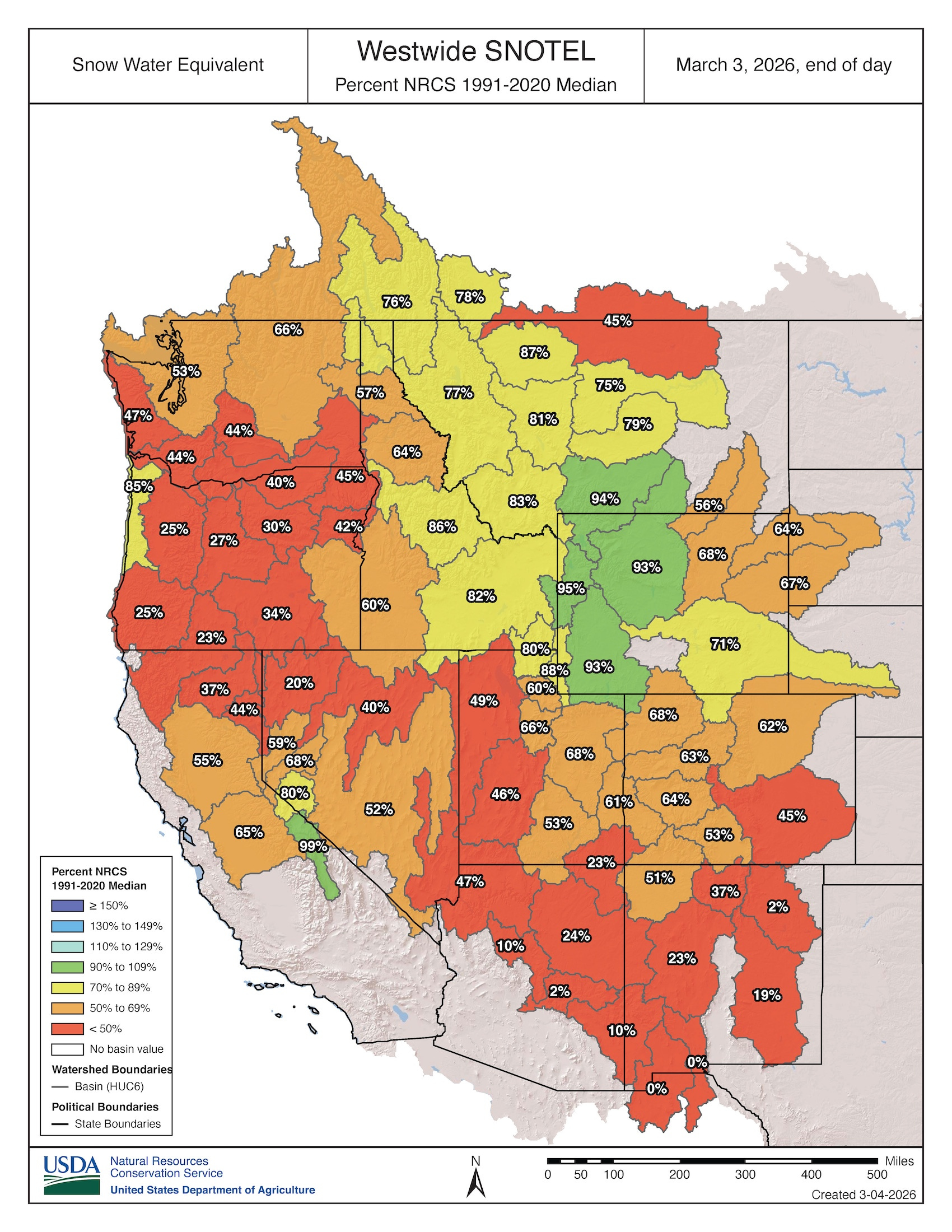
The snowpack is still looking sad across nearly all of the West. With each passing day, we’re nearing median peak dates as temperatures warm and the sun climbs higher and stays longer in the sky.
The map below shows snow water equivalent on March 3. Only a handful of river basins are at 90% or greater (green), and none are at 100% or more, while many watersheds remain below 50% (red).
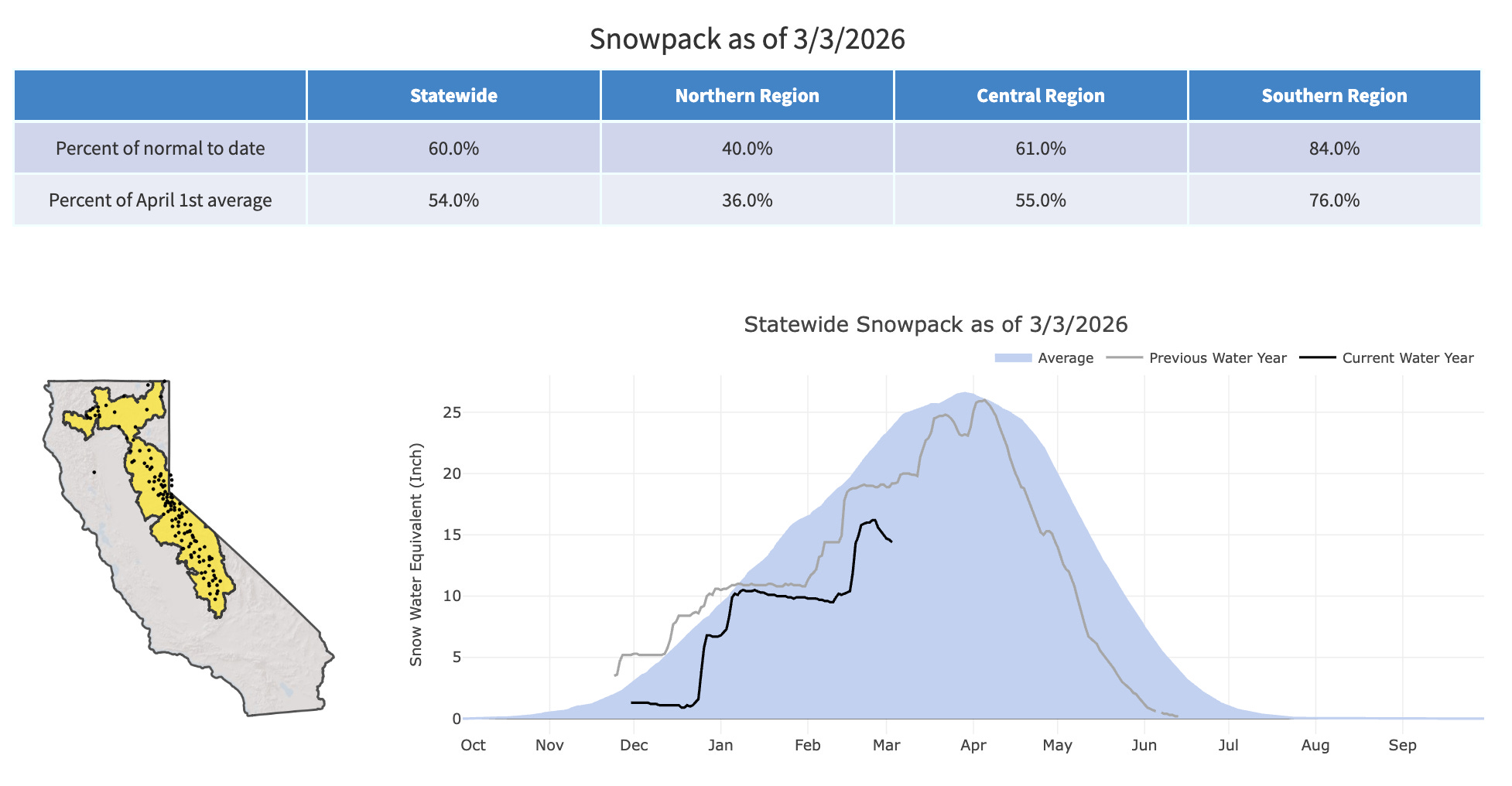
In California, the snowpack jumped after a series of February storms. But the black line in the March 3 chart below shows that the statewide level has declined since then. Overall, California’s snowpack stood at 60% of normal, with the northern region at just 40% and the southern region at 84%.
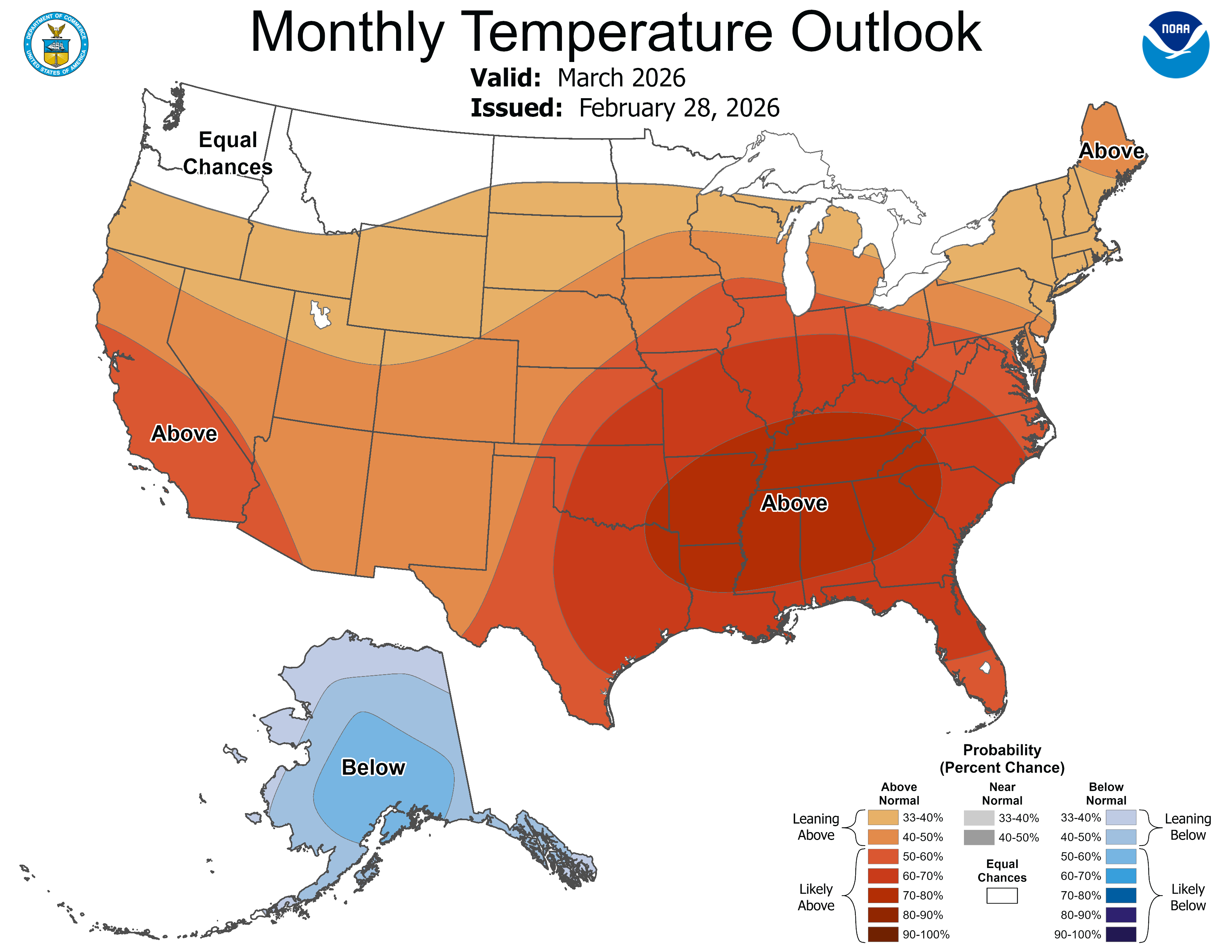
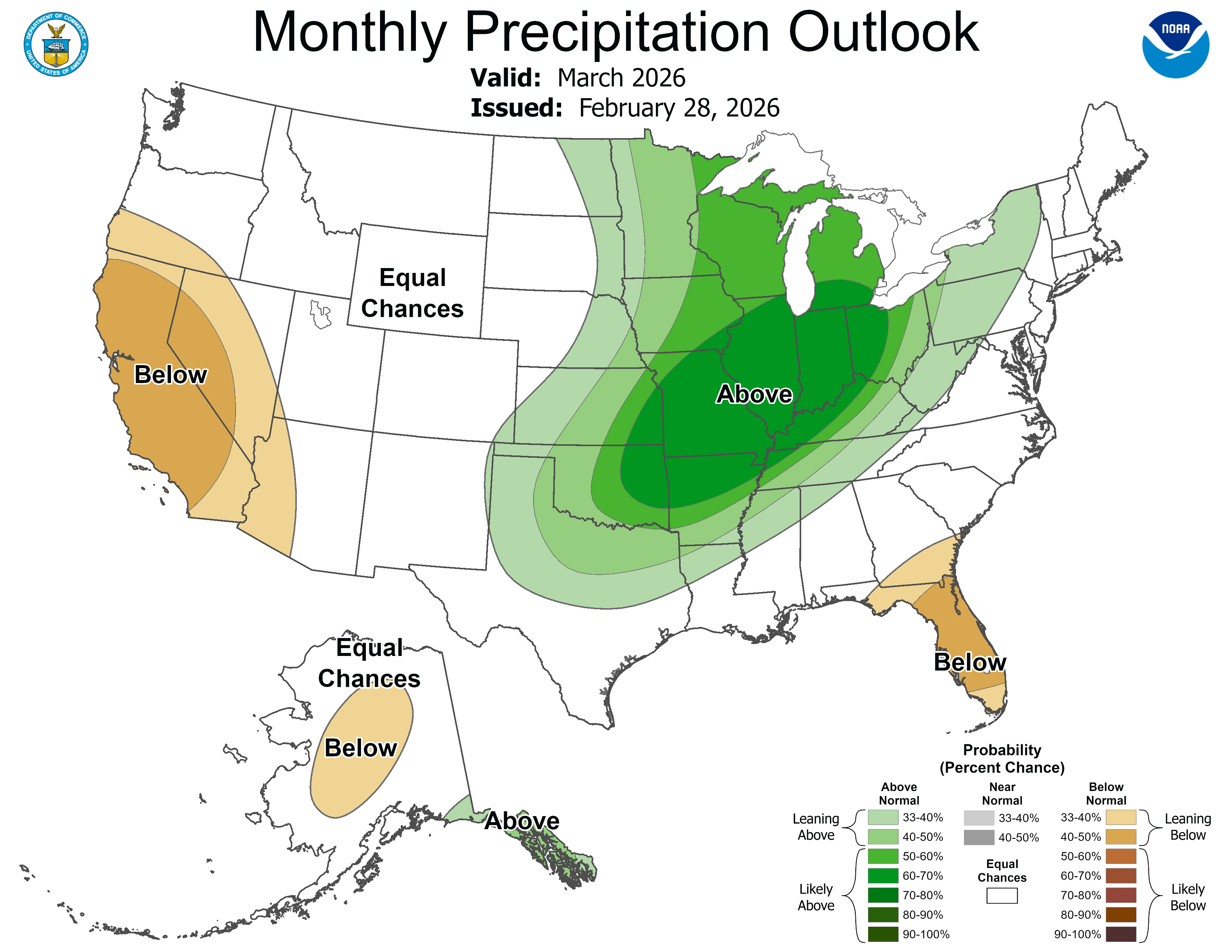
The two maps below, issued by the Climate Prediction Center on February 28, show the March temperature and precipitation outlooks. Across most of the West, the warmth is expected to continue, and there’s no signal for wetter-than-normal weather.
Every river basin has its own typical peak date, but in many places, April 1 is a key milestone for water managers and snow scientists. As we approach that waypoint, things ain’t looking good.
5) Our storm of the season?
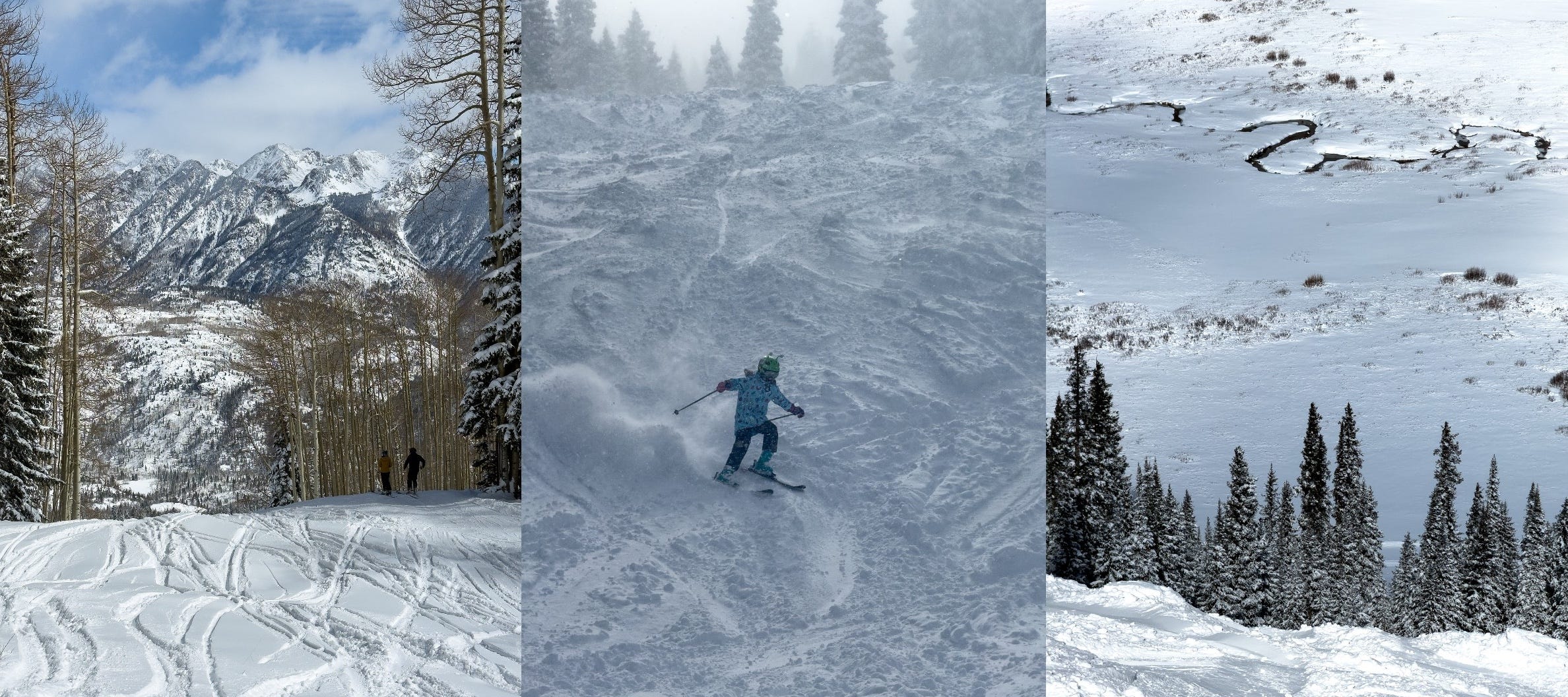
It’s now a fading memory, but here in southwest Colorado, we got walloped a couple of weeks ago by a major winter storm. It delivered about two feet to the snow.news headquarters, more than three feet to Purgatory—my home mountain—and nearly five feet to Wolf Creek.
I’m starting to think this storm was the highlight of an otherwise moribund season. The dump reinforced how much fun—and hardship—snow can entail.
The map below shows that the same storm that led to the Sierra Nevada avalanche disaster also delivered deep accumulations to our neck of the woods.
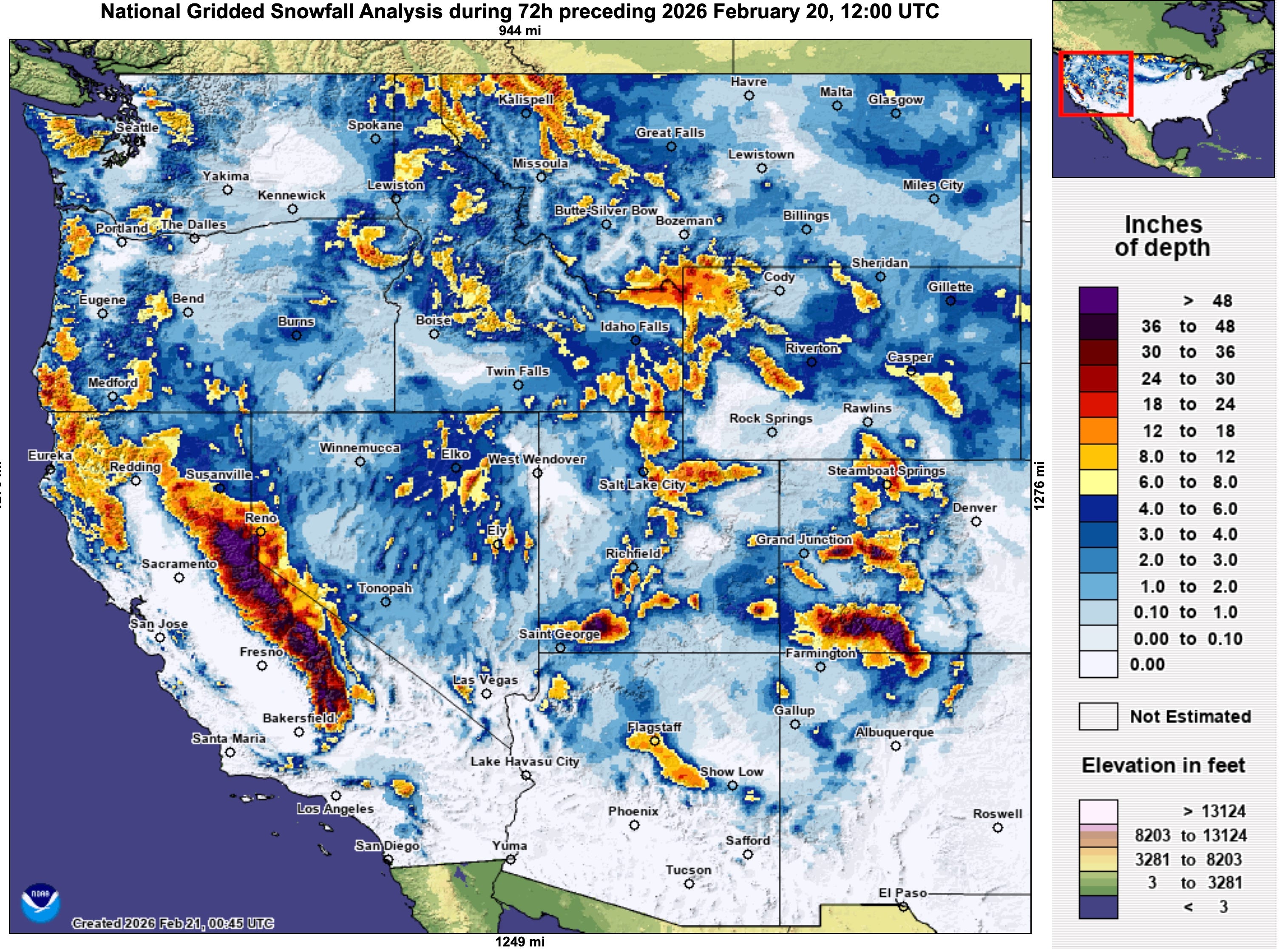
Those purple areas in the Sierra Nevada and Colorado’s San Juans paint a vivid portrait of the orographic effects that mountains exert on snowfall totals. I remember one National Weather Forecaster in Grand Junction describing the curving shape of precipitation totals in the San Juans as the Fertile Crescent, an allusion to the cradle of irrigated agriculture in the Middle East (which depends in part on snowmelt).
Knowing the storm was coming a week in advance, I rearranged my schedule to take off at least part of two days to ski. When I was a solo consultant, I even inserted a powder day clause into my LLC’s operating agreement that ratcheted down the snowfall threshold required to trigger a day off in future years—a nod to the warming climate.
Sadly, this double-barreled storm arrived a little faster than I anticipated, so I missed the biggest totals at Purgatory on February 18. But the next day I enjoyed cleaning up the leftovers.
The second round of snow closed local schools, so I was treated to a sweet, memorable father-daughter powder day—a bright spot in an otherwise lousy ski season. But the drive up to the slopes was painfully slow and, at times, harrowing, even with four-wheel drive and studded snow tires.
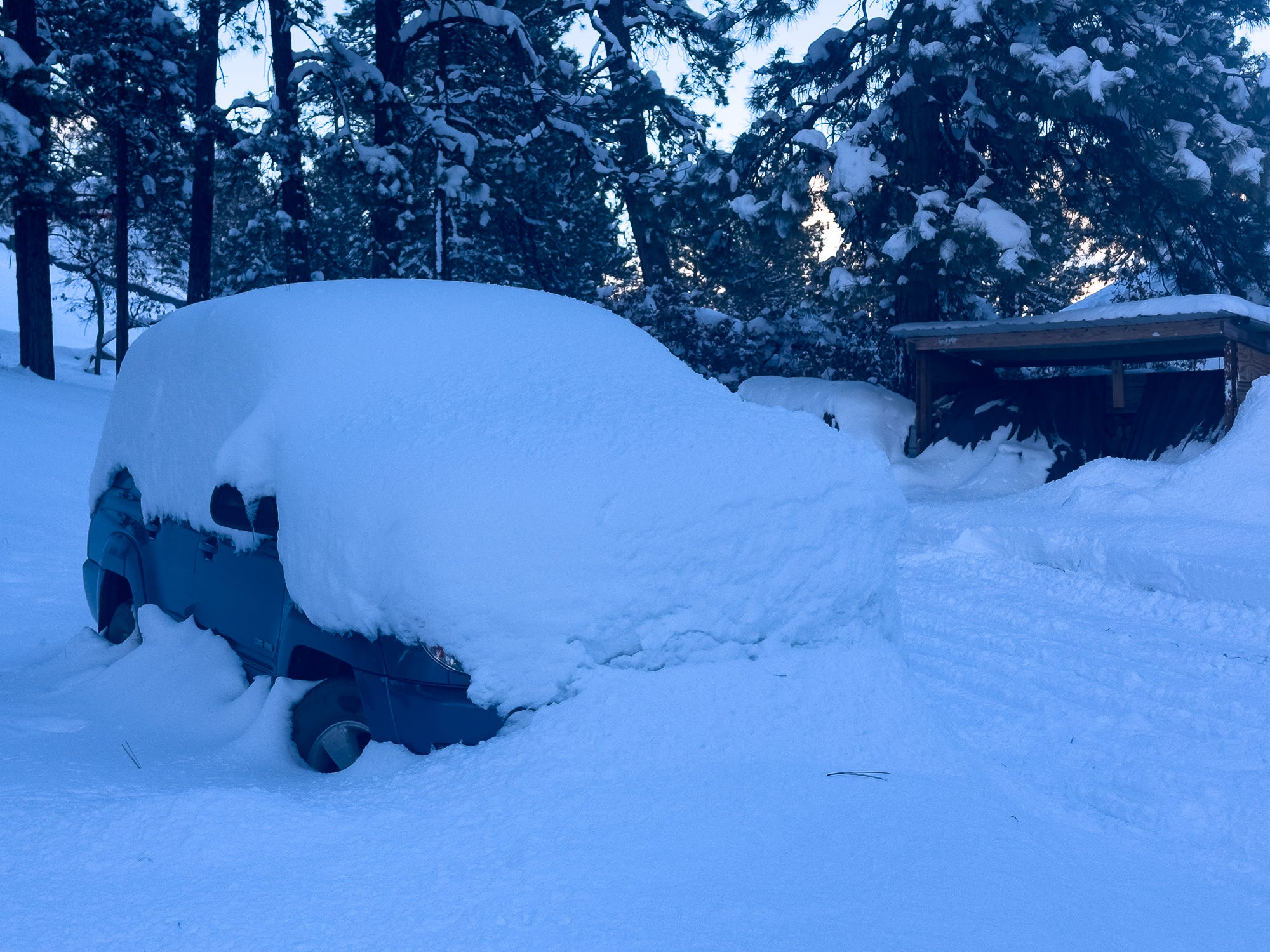
I have an on-again, off-again relationship with the guy who plows many of the driveways in our neighborhood. I suspect he feels jilted that I sometimes preempt his work and clear the way myself with an aging gas-powered snowblower we inherited from the previous homeowners. This storm, I got skipped, so the 100-foot driveway was my duty.
It felt good to engage with the snow mano a mano, and it was gratifying to save the money I would have paid for plowing. But it was also slightly nauseating to breathe the blower’s emissions, and definitely annoying to spend an hour fixing the beast with cold hands.
I’ve thought about getting an electric snowblower, but they’re pricey, and I’m not sure how much snow removal I’ll be doing in the future. This season and last, there hasn’t been much to blow.
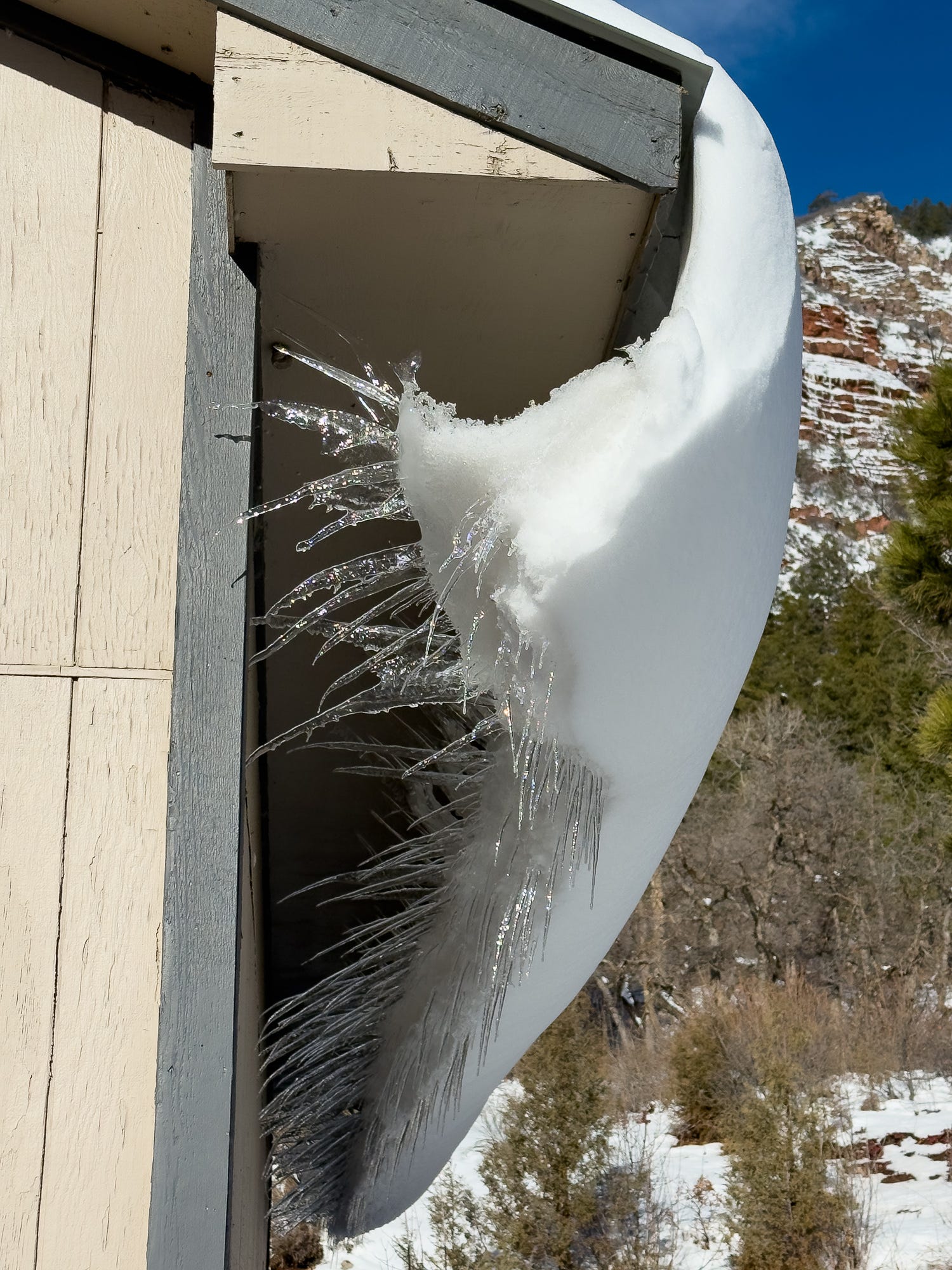
Last year, we added insulation to our attic, so our roof now holds snow longer because less heat escapes from the house. That’s provided a better tableau for observing snow’s metamorphosis. The photo below shows a slab ready to release—right onto the walkway to our front door.
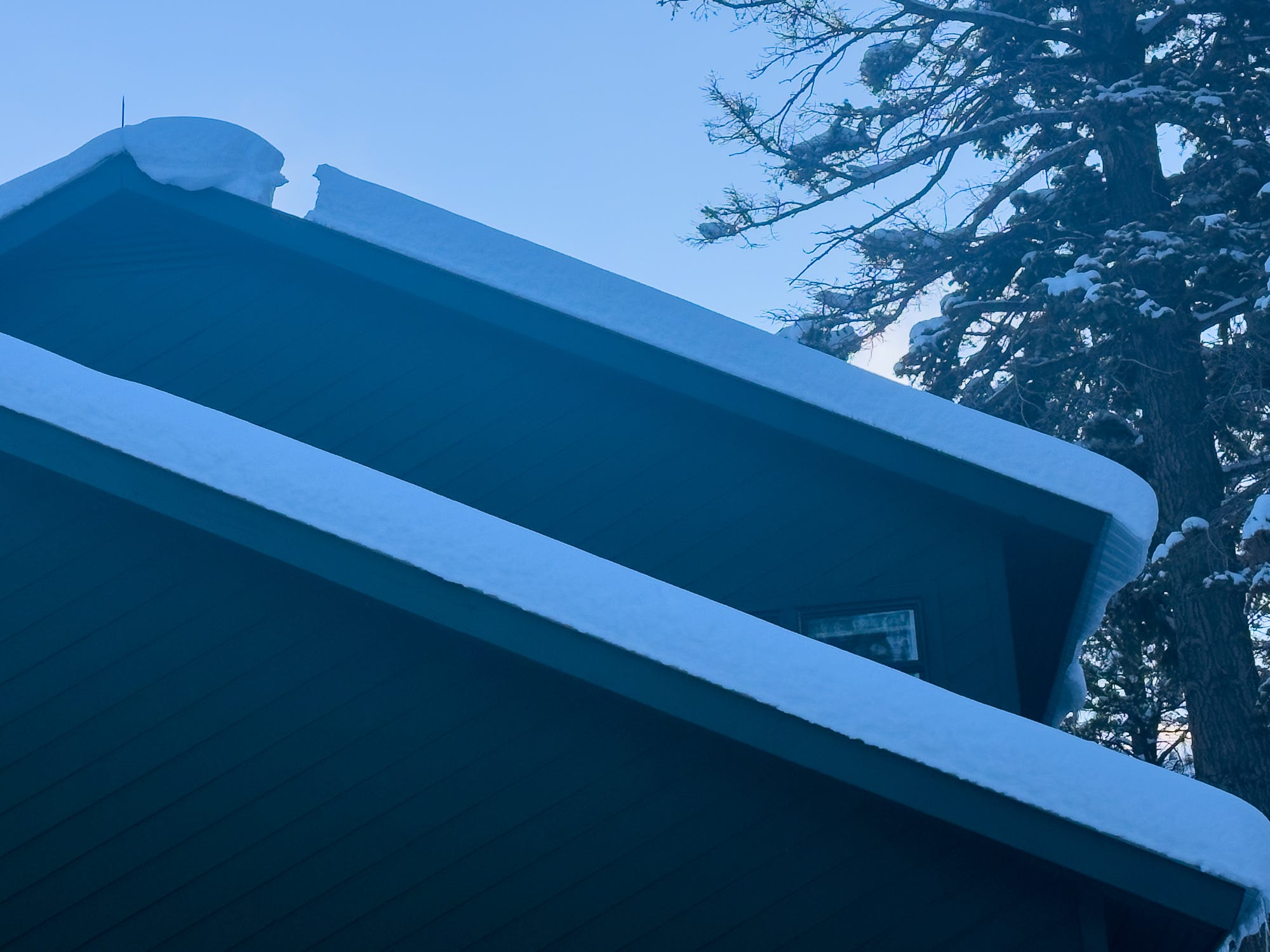
At unpredictable moments, huge snow masses crash down from our roof, startling anyone at home. The snow instantly compresses into dense debris that is tough to dig through, serving as a chilling reminder of the daunting task facing avalanche rescuers. My back was sore for days after shoveling the detritus from the roof—another sign that snow can be a real pain.
It’s been an unsettling winter here, and technically speaking, there are only a few weeks left until spring. I can’t stop overhearing people—at the supermarket, in the hardware store, on the chairlift—talking about the shocking lack of snow and mild weather.
When the days are short, I’m used to firing up the wood-burning stove to help heat the house. But many evenings this winter it’s been superfluous. And I now have failing muscle memory for shoveling snow and skiing powder.
It was so warm this past weekend that we skipped skiing to go camping, hiking, and biking (in shorts) in northwest New Mexico in a bid to turn lemons into lemonade.